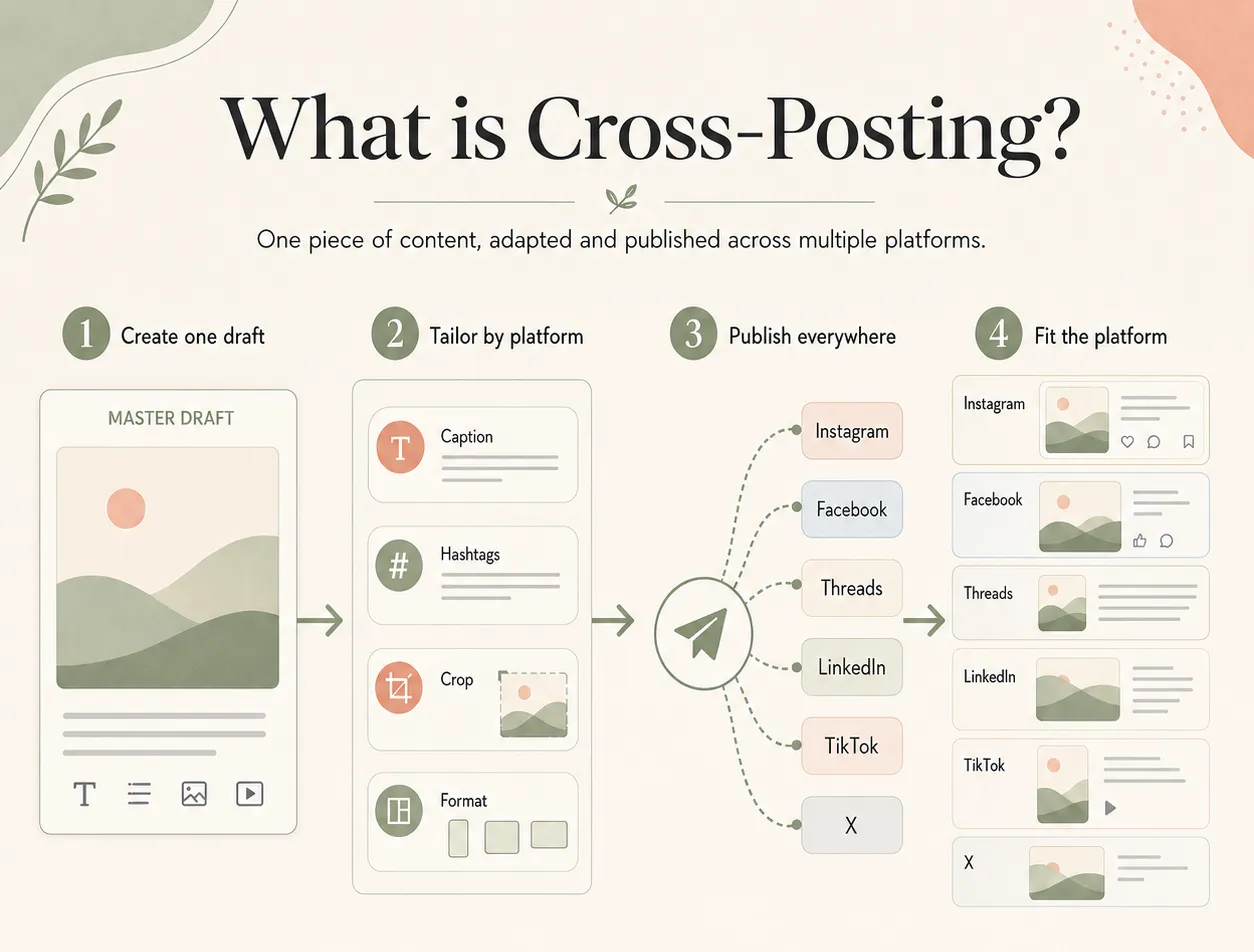
Cross-posting is taking one piece of social media content and publishing it to more than one platform at roughly the same time, either through a network's native sharing feature like Meta's Facebook to Instagram setup or through a third-party scheduler that pushes a single draft to several accounts in one go.
What is cross-posting?
Cross-posting is what happens when one post goes up on more than one account, run by you, in roughly the same window. The same photo, the same video, the same caption, with whatever small adjustments the publishing tool will let you make before it hits each platform. Hootsuite's glossary defines it as "the strategy of posting the same social media content across multiple channels", and Later's entry on cross-posting lands in the same place: one piece of content, several homes.
The word predates social media by a long way. The Wikipedia entry for crossposting traces it back to Usenet newsgroups in the late 1980s, where the Newsgroups header on a single message let a poster send the same text to several groups at once, and the etiquette argument about whether that was lazy or efficient has been running ever since. The social-media version inherited both the convenience and the argument.
In practice cross-posting splits into two distinct workflows with different mechanics. The native version is a feature Meta, Threads, and a few other platforms run inside their own apps, and the third-party version is a scheduler that takes one composer draft and ships it to a handful of accounts that have nothing to do with each other. Most brands use both, on different days, for different reasons.
Cross-posting vs reposting vs repurposing
These three get used as if they meant the same thing and they do not, which becomes a problem the moment someone in a meeting says "we should cross-post that" when what they actually mean is repurpose. The short version of the split:
Cross-posting
One piece of content, more than one platform, at roughly the same time, on accounts you run. The Reel that went to Instagram also went to TikTok this morning. The post that went up on LinkedIn also went up on Threads. The mechanism is automated or near-automated, and the time between the two posts is hours at most rather than weeks.
Reposting
The same content again, on the same platform, later. The Reel that did well in February gets reposted in May because the audience has turned over and a chunk of them missed it. Reposting on the same account is a long-running practice; reposting other people's content on an account that mostly trades on other people's content is the thing Instagram has been pushing back on in 2025 and 2026.
Repurposing
Meaningful transformation of the original. A long-form YouTube video becomes three short Reels, a single keynote becomes a LinkedIn carousel and four standalone Threads posts, a blog post becomes an Instagram carousel and an X thread. The work is in the rewrite and the recut. Repurposing is the version cross-posting is often pretending to be.
Cross-posting is the cheapest of the three to run and the easiest to get wrong, because nothing about the workflow forces the team to think about whether the post is actually right for the second platform. Repurposing is the most expensive and usually the highest performing. Reposting sits in between and is the one most brands underuse.
Native cross-posting on Meta (Facebook, Instagram, Threads)
Meta runs the most-used native cross-posting setup on the internet, mostly because the same company owns the four platforms involved. The flow lives inside Accounts Center, which is the shared settings layer behind Facebook, Instagram, and Threads, and it lets a Facebook Page, a professional Instagram account, and a Threads account share publishing across each other. Meta's help article on sharing posts, stories, and reels from a professional Instagram account to a Facebook Page is the canonical setup guide, and the equivalent in the other direction is the Share to Instagram toggle inside Meta Business Suite when posting from a Facebook Page.
Threads joined the same plumbing in stages through 2025 and 2026. The TechCrunch piece on Threads posts shared directly to Instagram Stories covered the February 2026 launch of in-app sharing from Threads to an Instagram Story, and the same Accounts Center setup lets Instagram and Facebook posts publish to Threads at the same time from the composer. What you get in practice is a single Meta-side draft, on a single shelf, that touches three feeds without a second tool involved.
Native cross-posting comes with limits worth knowing before the workflow gets relied on. Some content types do not cross cleanly: a carousel posted on Instagram does not always make the trip to Facebook intact, video aspect ratios that work for Reels can look stretched on the Facebook feed, and the share to a Facebook Page sometimes lands on the Page wall rather than as a separate native post the way the same content would if it were posted directly. The connection between the accounts also breaks more often than the help docs imply, and the first thing to check when a cross-post does not appear is usually the link in Accounts Center.
Other platforms run smaller versions of the same idea. TikTok has a built-in share to Instagram Reels and a share to a few other apps on the post screen, YouTube Shorts can be published and surfaced on the same account that owns the long-form videos, and X has a setting for posting to a linked Mastodon instance in some accounts. None of those are as deep as Meta's setup, and most brands that want one-to-many publishing across non-Meta platforms end up using a scheduler rather than chaining native features together.
Third-party cross-posting with schedulers
The wider definition of cross-posting that most marketers actually mean is the scheduler workflow: a single draft inside a tool like Buffer, Hootsuite, Sprout Social, Later, or EziBreezy that publishes to several accounts at once across platforms that have no formal relationship with each other. Buffer's practical guide to how to crosspost on social media is a clean walk-through of the standard flow, and the same composer pattern shows up across every major scheduler.
The shape of the workflow is consistent across tools. You write the caption once, attach the image or video once, and tick the platforms the post should go to. The tools that take cross-posting seriously then let you override the caption, the hashtags, the first comment, the crop, and the link preview on a per-platform basis before the post ships. The ones that do not turn into a paste-once-publish-everywhere machine, which is the version of cross-posting that gives the practice its bad name.
Single composer, many platforms
The base feature every scheduler supports. One draft, a row of platform toggles, one publish button. The minimum viable version of cross-posting and the one most teams use day to day.
Per-platform caption overrides
The single feature that separates a tool worth using from a tool that produces obvious paste-jobs. The same draft with a tighter caption for X, a longer one for LinkedIn, hashtags only on Instagram, and a line break pass for the platforms that respect them.
Per-platform crop and aspect ratio
Square for Instagram feed, 9:16 for Reels and TikTok, 16:9 for YouTube, 4:5 for LinkedIn carousels. A scheduler without per-platform crop forces a single aspect ratio onto every network, which is usually 1:1 and looks awful on three of them.
Staggered publishing
The same post going to every network on the same minute is the loudest signal that the brand is cross-posting on autopilot. Spacing the posts even fifteen minutes apart hides most of the seams. Hootsuite makes the case for staggering in its guide to posting to multiple networks at once, and the same advice shows up in every credible cross-posting playbook.
Per-platform first comment and link
Instagram hides external links inside captions, LinkedIn rewards a link in the first comment over one inside the post, X happily takes the link inline. A scheduler that supports a different first comment and a different link per platform handles the three cases in one workflow rather than three.
Analytics back in the same place
The point of running a scheduler instead of native cross-posting is the reporting. Reach, saves, comments, and click-through across every cross-posted version of the same idea, side by side, so the next round of cross-posting knows which platform actually carried the post.
The honest read on the scheduler market is that all of the bigger tools support the base feature and most of them support the overrides. The difference between them is how much friction the override path has, which is the difference between a team that actually uses the per-platform editing every time and a team that quietly stops bothering after the first month.
Does cross-posting hurt your reach?
The short answer is that Meta has not said publicly that posting your own content to your own Facebook Page and your own Instagram account triggers a ranking penalty. What Adam Mosseri has said, repeatedly through 2025 and into 2026, is that the recommendation system on Instagram favours content that is original to the platform and that aggregator accounts whose feeds are mostly other people's reposted work will stop being recommended to non-followers. PetaPixel covered the most recent version in its piece on Instagram's new policies on reposted content, quoting Mosseri directly: "If most of what you post to Instagram is someone else's content, your account is no longer going to be recommendable."
That is a rule about who made the content, not about how many platforms you posted it to. A brand cross-posting its own photography from Instagram to Facebook is not the target. Buffer's cross-posting guide reaches the same conclusion from the other side, putting it plainly: there is no clear evidence that the major platforms directly penalise creators for cross-posting.
Where the underperformance shows up is subtler than a penalty. The same caption written for an Instagram audience tends to read flat on LinkedIn, the same opening line that lands on X tends to die in a Facebook feed, the same vertical video that plays cleanly on TikTok tends to get cropped wrong on Facebook. The reach drop on the second platform is usually a signal that the post was written for the first one, not that a ranking algorithm noticed a duplicate. Hootsuite makes the same point in its broader take on posting to every network at once, which lands on a clear "probably not" for identical posts and a softer "yes, if you tailor it" for the same content with per-platform adjustments.
The per-platform tailoring trade-off
Cross-posting only saves time if you stop adjusting the post for each platform, and the post only performs if you keep adjusting it. That is the real trade-off, and most of the cross-posting debate is people pretending they have solved one side without paying the cost on the other.
The places the tailoring matters most are predictable. Length, because LinkedIn rewards a longer draft and X cuts off at 280 characters. Hashtags, because Instagram and TikTok still pull signal from them in 2026 and LinkedIn and Facebook mostly do not. Calls to action, because "link in bio" means something on Instagram and nothing on LinkedIn. Aspect ratio, because a vertical video posted in a square feed is the clearest signal a brand is cross-posting on autopilot. Tone, because Threads sounds like text messages, LinkedIn sounds like a conference talk, and the same draft cannot do both without picking a side.
The pragmatic version of tailoring is a small set of repeated edits the team runs every time a post goes to more than one platform. A pass on the first sentence. A pass on hashtags. A pass on the link. A pass on the crop. A pass on the call to action. None of them take long on their own, all of them together get skipped under deadline, and the brands that cross-post well are the ones that have made those five passes a default rather than a decision. The connection to a broader caption practice is direct: a caption that works on every platform usually does not work especially well on any of them.
When cross-posting is fine vs when it backfires
Cross-posting is fine more often than the strict-tailoring camp gives it credit for, and a disaster more often than the post-everywhere camp likes to admit. The dividing line is usually how close the platforms are in tone and format, and whether the post is the kind of content that travels well.
Fine: announcement posts to Facebook and Instagram
A product launch image, a new opening hours card, a stock-back announcement, a holiday closure. The two networks share an audience, a caption style, and a feed layout, and Meta's own native cross-posting handles the publishing. The caption rewrite for these is so light that running it twice usually costs more time than the second draft saves.
Fine: vertical short-form video across Reels, TikTok, and Shorts
Three platforms that have effectively converged on the same content shape. The same nine-by-sixteen video with a clean opening and a hook in the first second works on all three, as long as the caption gets a per-platform pass and any watermark from the original platform is removed before the cross-post.
Fine: linked external content across LinkedIn, Threads, and X
A blog post, a podcast episode, a newsletter, a piece of company news. Different paragraph counts and different first sentences per platform, same underlying link. The shape of the content travels well across the three text-led platforms, and cross-posting saves a real chunk of the working day.
Backfires: identical captions written for one network
An Instagram caption that opens with three line breaks, a row of hashtags, and an emoji-led first line, dropped untouched into LinkedIn. The reach drop is not a ranking penalty, it is the LinkedIn audience reading the post and bouncing off the formatting in two seconds. The post performs as expected: nobody reads past the second line, and the comments never arrive.
Backfires: cross-posting trends across audiences that do not share them
A TikTok trend that depends on knowing the original sound, the original creator, and the joke, cross-posted to a LinkedIn audience who do not. The asset is the same, the cultural context is gone, and the post reads as if a brand wandered into a conversation it was not part of.
Backfires: anything with platform-specific UI baked in
Visible TikTok watermarks, Instagram-only stickers, an end card that says "link in bio". Mosseri's repost guidance picks the TikTok-watermarked Reel out as a specific example of recycled content that gets demoted, and the same logic applies in reverse on the other platforms. Remove the watermark or do not cross-post the asset.
Most brands settle into a mixed model: native cross-posting for the Meta side, scheduler cross-posting for the announcements and links across the wider set, and a separate repurposing track for the higher-stakes posts that deserve a proper rewrite for each platform. The mixed model is the version that actually saves time without quietly draining reach on the second platform.
Common cross-posting mistakes
The mistakes below show up in almost every cross-posting setup within a few weeks of the scheduler going live. Each one is fixable, most of them in an afternoon.
- Treating cross-posting as a replacement for a content plan. A scheduler that publishes one draft to seven platforms is a publishing tool, not a strategy. The brands that struggle with cross-posting almost always started using the feature before they decided what each platform was actually for. See the content pillars entry for the planning side this gap usually points to.
- Cross-posting at the same minute across every platform. The simultaneous publish is the loudest signal the team is on autopilot. Stagger the posts by fifteen minutes, half an hour, an afternoon, and the seams stop being obvious. The best window for each platform is rarely the same time of day anyway.
- Leaving the wrong call to action in place. "Link in bio" on LinkedIn, "swipe up" on a feed post, "duet this" on Reels, "retweet if you agree" on Threads. Each of those is a clear signal that the post was written somewhere else and never reread before it shipped.
- Cross-posting watermarked video. TikTok watermarks on Reels and Instagram-source watermarks on TikTok both fall directly inside the recycled-content guidance Mosseri laid out in 2025. The fix is to export from the original platform without the watermark or to download the source asset before posting anywhere.
- Sharing a carousel that does not survive the trip. Native cross-posting between Facebook and Instagram still drops carousels in places, and a scheduler that does not confirm the carousel landed on the destination is the quickest way to discover this two days later. Check the destination post the first few times the workflow runs.
- Letting the inbox split across platforms with nobody assigned. Cross-posting multiplies the surface area the comments can land on. A team that publishes the same post to six platforms and answers comments on one of them looks worse, not better, than a team that posted to two and answered on both.
- Skipping the post-mortem because the post went up. The scheduler said it shipped, the calendar moved on, and nobody opened the reporting tab to see which platform actually carried the post. Cross-posting that nobody reviews turns into a paste-everywhere machine inside two months. A short weekly look at which platform carried which post is what keeps the workflow honest.
For the wider context cross-posting sits inside, the algorithm entry covers what each platform actually rewards and the batching entry covers the production workflow that feeds the scheduler in the first place.
Cross-posting FAQ
Does cross-posting hurt your reach on Instagram or Facebook?
There is no public statement from Meta that posting your own content to your own Facebook Page and your own Instagram account gets the post downranked. What Meta has said clearly is that aggregator accounts that mostly repost other people's content will stop being recommended to non-followers, and that Instagram's recommendation system favours posts that are original to the platform. The practical effect for a brand cross-posting its own work is small: identical captions tend to underperform because they were written for one platform and skim badly on the other, not because a ranking signal flips when the same image goes up twice.
What is the difference between cross-posting and reposting?
Cross-posting is taking one piece of content and publishing it to more than one platform at roughly the same time, usually your own Facebook, Instagram, LinkedIn, X, Threads, or TikTok account. Reposting is putting the same content up again on the same platform, often weeks or months later, sometimes with a small edit. Repurposing is the wider word people use when the content gets meaningfully changed for the new platform: a Reel cut from a long-form YouTube video, a carousel pulled out of a blog post, a Threads post written from a LinkedIn essay. Cross-posting is the most automatic of the three and the most likely to look lazy if nobody adjusts anything.
Can you cross-post from Facebook to Instagram automatically?
Yes, in both directions, using Meta's built-in tools. From Instagram, the Share to Facebook toggle on the final post screen sends the post to a linked Facebook Page. From Facebook or Meta Business Suite, a Page can publish a post to a connected Instagram professional account at the same time. Meta's setup runs through the Accounts Center, the Page needs to be linked to the Instagram account, and the Instagram account has to be a Business or Creator profile. The same plumbing now extends to Threads, where Instagram and Facebook posts can be cross-posted to a Threads account from the composer.
Should you cross-post the same content to LinkedIn and X?
Usually not without a rewrite. LinkedIn rewards longer paragraphs, line breaks, and a slower opening; X rewards a sharp first sentence inside 280 characters and almost no setup. The same idea works on both, the same words almost never do. The practical pattern most teams settle on is one core insight, two different drafts: an X version that lands the punchline first and a LinkedIn version that earns it over three or four paragraphs. Pushing the LinkedIn draft to X gets truncated, and pushing the X draft to LinkedIn looks thin against the rest of the feed.
What is the best cross-posting tool?
For native cross-posting inside Meta the answer is Meta Business Suite, because the Facebook and Instagram integration is run by Meta itself and the smaller tools cannot match the reliability of a first-party setup. For everything across platforms, the choice is a scheduler. Buffer is the simplest free option. Hootsuite, Sprout Social, and Later are the bigger paid tools used by larger marketing teams. EziBreezy sits in the middle for solo founders and small teams, with one composer that publishes to Instagram, TikTok, LinkedIn, X, Threads, Facebook, YouTube, and Pinterest, plus per-platform overrides so the same idea ships with the right caption, hashtags, and crop for each network rather than one paste job everywhere.