A feed in social media is the running list of posts that loads when you open an app like Instagram, TikTok, Facebook, LinkedIn, X, or YouTube, ordered by the platform's ranking software so that the posts the system predicts you will spend time on sit closest to the top of the screen and the rest get pushed down or left out.
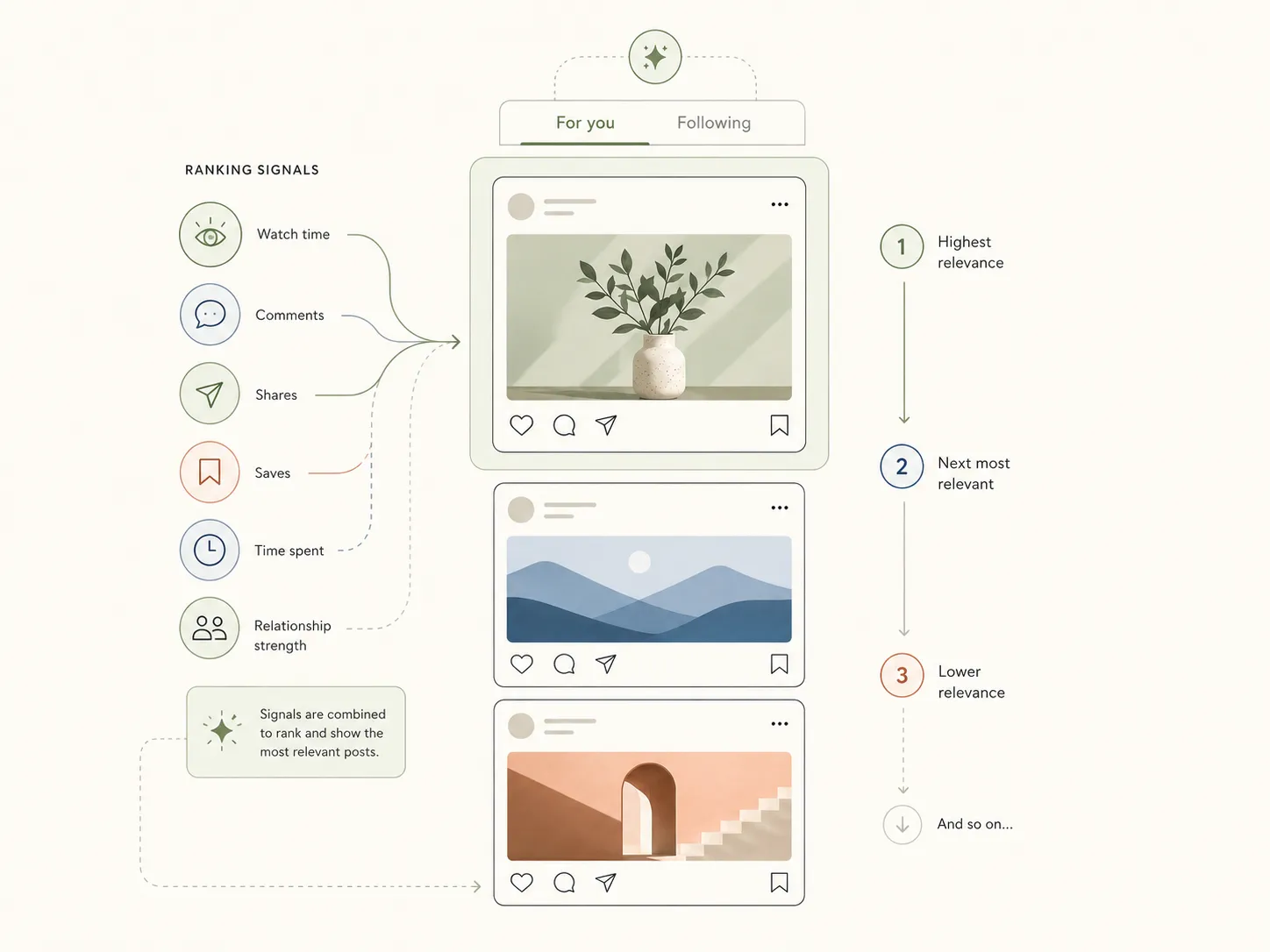
What is a feed in social media?
The feed is the home screen of social media. Open Instagram and the first thing on the screen is a column of posts. Open TikTok and the first thing on the screen is a stack of vertical videos. Open Facebook, LinkedIn, X, Threads, or YouTube, and the same pattern repeats: a long, scrollable list of posts from a mix of accounts you follow, accounts the platform thinks you would like to follow, and a small share of paid posts slotted in between. Buffer's glossary defines a feed as a stream of content you see on apps like Instagram, LinkedIn, and Facebook, which gets at the shape of the thing in a sentence.
The reason the feed matters so much for anyone making content is that the feed is where the content gets watched or skipped. A post that the feed decides not to surface might as well not exist for the viewer who would have liked it. A post that the feed surfaces to the right audience can carry a brand through a quarter. The whole job of social media marketing, in some sense, is the job of getting work into more feeds, into the right feeds, and into the top of those feeds for long enough that the viewer actually stops scrolling.
The other reason the word matters is that it is doing too much work at once. Inside the same app, the same word can mean the main timeline (the column of posts), a specific tab in the app (the Feed tab on Instagram or the Feeds tab on Facebook), a scheduler tool's grid view of a profile, and an older technical syndication format like RSS. Most of the confusion in conversations about social media feeds is people using one of those senses and being heard in another.
Where the word feed comes from
The web feed predates the social feed by about a decade. The Wikipedia entry on web feeds traces RSS back to its first releases in 1999, with Atom and later JSON Feed following on. The basic idea was a syndication format that let a website push its latest items to subscribers in a standard shape, and the same word, feed, stuck to the thing the subscriber saw inside their reader. By 2005 most of the major news sites had an RSS feed and most readers had their own reader app, and the language of feeds was settled before social media existed.
The social media version of the feed arrived on Facebook on September 6, 2006. The Wikipedia entry on Facebook's Feed records the launch and the immediate user revolt that followed, and notes that Facebook started reordering posts on top of the strict chronological view as early as September 2011. The News Feed (later renamed simply Feed) was the first of the modern social timelines, and the design pattern that every other platform copied across the next ten years.
The next big move was the shift from chronological to algorithmic ordering across the rest of the major networks. Twitter announced an algorithmic timeline in March 2016 and Instagram followed in June 2016, both with a long tail of user pushback under hashtags like #RIPTwitter. Vice's piece on why 2016 was the year of the algorithmic timeline is the cleanest contemporary write-up of that year, and the broader Wikipedia entry on algorithmic curation gives the wider context. The shift was not a sudden cliff. By 2018 every major feed was algorithmic by default, and the only debate left was how much of a chronological option to keep around the edges.
Algorithmic vs chronological feed
These two are easy to describe and easy to get wrong when planning content, so it is worth stating the difference plainly before getting into per-platform mechanics.
Chronological feed
Posts in reverse time order: the newest one at the top, the next newest below it, and so on. The only signals that matter for ordering are who you follow and when they posted. The audience for a chronological feed is the people who happen to open the app inside the post's natural window, which is roughly twenty-four hours on most platforms and as little as a few hours on the fast-moving ones like X and TikTok.
Algorithmic feed
Posts in whatever order the platform's ranking system predicts you will spend time on, often pulled from a wider pool than the accounts you follow. Recency is one signal among many: a strong post from a follower three days ago can sit above a weak post from the same follower an hour ago, and a post from an account you have never seen can land above both if the system thinks the topic fits. The audience for an algorithmic feed is the audience the system decides to assemble for you, which is much larger than the people who happened to be in the app this morning.
What flipped between 2009 and 2016
Facebook started reordering posts on top of strict reverse-chronological in 2009 and was fully algorithmic by 2011. Twitter went algorithmic in March 2016 with an opt-out. Instagram went algorithmic in June 2016 with no opt-out at all. TikTok was algorithmic from the day the international app launched in 2018, because the For You feed was the product from the start. By the time YouTube replaced the subscriptions-first home page with the recommendation grid, the chronological era was over.
What still runs chronologically
The YouTube Subscriptions tab, the Instagram Following and Favorites tabs (added in 2022 and still around), the X Following tab, the Facebook Feeds tab Recents view, the Threads Following tab, the LinkedIn Recent sort on the home feed, and almost every RSS reader. These exist as a secondary surface on every major platform. None of them are the default for any non-power-user.
The practical implication for anyone planning posts is that the chronological audience and the algorithmic audience are almost entirely different groups of people. The chronological audience is small, loyal, and happens to be in the app when you publish. The algorithmic audience is much larger, mostly new to the brand, and is assembled by the system over the following hours and days. Posting strategy aimed only at the chronological audience is posting for a room that mostly emptied out in 2016.
For You feed vs Following feed
The For You and Following split is the modern compromise between the two camps. TikTok shipped it first, X copied the pattern in early 2023, Instagram added a similar Following tab in 2022, and Threads followed when the app launched in 2023. The basic shape is the same on each platform: the default tab is an algorithmic feed that pulls heavily from accounts you do not yet follow, and a second tab gives you a chronological view of the accounts you have explicitly chosen.
TikTok's own explainer on the For You feed is the clearest first-party description of how the split is meant to work. The For You feed is the discovery surface: the platform learns what you like from interactions, then uses collaborative filtering to compare your interests with users who like similar things, and the recommendations shift as your taste shifts. The Following feed exists alongside it for when you want to see only the accounts you have committed to. On the same app, the two tabs feel like two different products.
On X, Sprout Social's guide to how the X algorithm works describes the same shape: a For You timeline as the default, a Following timeline as the secondary tab, and the For You version pulling in posts from outside the user's network through a heavy-ranker scoring model. On Instagram, the main Feed tab is the algorithmic default and the Following and Favorites views sit one tap away. On LinkedIn there is no explicit For You vs Following split, but the same logic is baked into the home feed's default Top sort versus the Recent sort that members can switch to manually.
The thing to keep in mind for content strategy is that the For You audience and the Following audience overlap less than the layout suggests. The Following audience is the people who already chose you and is roughly the same size as your follower count. The For You audience is everyone the recommendation system might decide to show your post to next, which on a good post can be ten or a hundred times the Following number, and on a weak post can be smaller than the Following number because the system never pushes it beyond your existing followers.
How each platform's feed actually works
Every platform has its own feed, its own surface vocabulary, and its own ranking system. The short version per platform is below, with the public sources each company has put out where they exist.
Instagram Feed
The main Feed tab is the algorithmic home of square, portrait, and carousel posts, plus single-video posts under three minutes. The Reels tab is a separate vertical-video feed with its own ranking system. Stories sit at the top of the Feed in a horizontal tray. Adam Mosseri's Instagram Ranking Explained post is the canonical first-party description: the Feed considers your activity, the post's information, the poster's information, and your history of interaction with them, and the five signals the team watches most closely are time on post, comments, likes, shares, and profile taps.
TikTok For You feed
The default tab and the product itself. TikTok's own For You feed explainer describes the system as a recommendation engine that learns from your interactions (likes, comments, follows, completes), the information attached to each video (sound, hashtag, caption), and your settings (language, country), then uses collaborative filtering to compare your taste with similar users. The Following feed sits behind a tab and shows accounts you follow in roughly chronological order.
X For You and Following timelines
The For You timeline is the algorithmic default and pulls in posts from outside your network through a heavy-ranker scoring model that predicts likelihood of engagement. The Following timeline shows your followed accounts in mostly reverse-chronological order, with a small amount of light algorithmic ordering inside the same time window. Sprout Social's X algorithm guide treats the For You version as the primary feed and the Following one as the secondary.
LinkedIn home feed
A single home feed that sorts by Top by default and can be switched to Recent. LinkedIn moved to an LLM-powered dual-encoder ranking model in 2026 and has been public about the shift toward knowledge-and-advice content over personal updates, with dwell time and comments doing most of the ranking work. Comments carry several times the weight of a like in the current model.
Facebook home feed
The original social-media feed, still mostly algorithmic and still the default home screen on facebook.com and the Facebook mobile app. A separate Feeds tab launched in 2022 lets users switch between Home (algorithmic), Friends (people you follow, chronological), Groups, Pages, and Favorites. Meta has been public about prioritising 'meaningful social interactions' in the ranking since 2018, which in practice means comments and shares between people who know each other.
YouTube Home and Subscriptions
YouTube runs two main feeds and the difference between them is significant. Home is a fully recommendation-driven grid that pulls from outside your subscriptions. Subscriptions is a reverse-chronological list of new uploads from channels you have subscribed to. Most YouTube watch time globally comes from the Home recommendations and the Up Next column rather than from Subscriptions, which is why subscriber count is a much weaker predictor of total reach on YouTube than it is on platforms like LinkedIn.
For a deeper read on the ranking systems themselves, the Hootsuite, Buffer and Sprout Social guides to the Instagram algorithm all cover the same five Feed signals Mosseri named, and the EziBreezy algorithm entry covers the broader ranking-system idea across every platform without getting stuck in any single one.
What gets a post into a feed
The signals every platform watches are not a secret. The big platforms have all published their own short lists, and the lists overlap enough that you can read them as one. The version below is the union of what Instagram, TikTok, X, LinkedIn, and YouTube have said publicly about Feed and For You ranking, with the per-platform weighting collapsed into a single view.
Time spent on the post
The single most predictive signal across feed ranking on every platform. The system watches whether someone stops scrolling, how long they stay, whether they tap to expand, and whether they finish a video. Mosseri's Instagram explainer puts time on post first, TikTok's For You system treats watch time as the strongest signal in the For You feed, and LinkedIn uses dwell time on long-form posts as a core part of its ranking.
Comments, replies, and the conversation that follows
Comments are heavier than likes on every algorithmic feed and several times heavier on LinkedIn specifically. A post that opens a real conversation in the first hour ships much further than a post that earns the same number of likes silently. The early window matters: the conversation has to start before the platform has decided whether to keep pushing the post out.
Shares and sends, especially via DM
Sharing a post to a friend in a DM is the strongest single ranking signal on Instagram Reels and one of the top three on Feed, by Mosseri's own framing. The same pattern shows up on TikTok, where shares outside the app are watched closely, and on X, where reposts and quote-posts carry more weight than likes. The thinking from the platform side is straightforward: if you cared enough to send the post to someone in particular, the system treats that as a strong endorsement.
Saves and bookmarks
Less universal but increasingly important on Instagram and Pinterest. A save signals that the post is useful enough to come back to, which in turn signals that the post is worth showing to other people who might find it useful. Saves do not carry the same weight on TikTok or X, where the ephemeral feed model puts more value on completes and reposts.
Profile taps and follow-throughs
Tapping through to a profile after seeing a post is the signal that the post earned interest in the creator, not just the post itself. Instagram counts profile taps among the five core Feed signals, and the same metric drives the discovery flywheel on TikTok, where a strong post often earns a flood of new follows in the same forty-eight hours.
Relationship strength and history
Every Feed system gives weight to who the viewer has interacted with before. The closer the relationship (more likes, more comments, more DMs, more profile visits), the higher the prior probability that the next post from that account ranks well. This is the reason a post from a friend who never goes viral can still sit near the top of a Feed: the relationship score carries it.
Originality and content quality classifiers
Each platform now runs at least one classifier that demotes content the system thinks is recycled or low quality. Instagram's recent crackdown on aggregator accounts is the loudest version; LinkedIn's downranking of obviously-AI-generated posts is the quieter one. The signal is binary in effect: pass the classifier and the rest of the ranking applies as usual, fail it and the post is held back regardless of how well it would have performed on the engagement signals.
The signals are weighted differently per platform and per surface (Feed and Reels on Instagram are ranked by different models even though the company is the same), but the family resemblance is real. A post written to earn time on post, comments, sends, and saves on one network is unlikely to flop on another for ranking reasons; the failures across feeds usually come from format and tone fit, not from a single platform's signals being wildly different from the others. The wider read on platform-specific signals is on the engagement rate entry, which covers how each of these signals turns into a single comparable number across platforms and over time.
The Instagram-grid sense of feed
There is a second meaning of the word feed that lives almost entirely inside Instagram and the tools that orbit it. When a designer or a brand strategist says they are planning their feed, they usually mean the three-column grid of squares that shows up on a profile when someone taps through. The grid is the same content as the main timeline, seen from the poster's side and laid out in publishing order rather than ranking order, and it has its own visual conventions that have nothing to do with the algorithm.
The grid view is what feed-planning tools like Planoly, Later's visual planner, Preview, and the EziBreezy grid view are built around. You drag the next nine posts into the slots they will occupy, look at the result as a three-by-three block, and adjust until the grid reads as a coherent surface rather than nine unrelated tiles. The puzzle-feed trend, the alternating-colour grid, the column-per-pillar grid, and the every-third-post-is-a-quote grid are all attempts to make the grid say something on its own. Most of these are at least partly out of fashion in 2026, with the field moving toward a simpler one-good-post-at-a-time approach as carousels and Reels have taken over the discovery side.
The thing worth knowing about the grid sense of feed is that the audience for the grid is a much smaller, more loyal subset than the audience for the algorithmic Feed tab. The grid is what a new visitor sees in the first ten seconds after tapping through from a Reel they liked, which makes it a profile-first-impression surface more than a distribution surface. The pillars and the visual cohesion show up most strongly here, which is why the content pillars framing fits the grid better than it fits the feed.
Common mistakes with feeds
The mistakes below show up almost every time a brand has been running social for a year or two and the strategy was written before the audience split between the Following feed and the For You feed. Most of them are fixable inside a quarter once they are named.
- Posting only for the chronological audience that no longer exists. Picking the perfect posting time and writing for the followers who are in the app right now is a strategy built for the 2014 Instagram. On a 2026 Feed, the post is competing for the For You slot for the next two days, not the Following slot for the next twenty minutes. Timing still matters at the margins, but the bigger question is what the post does in its first hour to earn the recommendation system's attention.
- Ignoring the For You audience entirely. The mirror-image mistake. A content calendar that only talks to existing followers in the language they already share leaves most of the platform's reach on the table. The For You audience is bigger than the Following audience on every algorithmic feed, and a post that assumes context the new viewer does not have gets scrolled past inside two seconds.
- Treating the Instagram grid as the finished design. A brand that puts hours into the visual cohesion of the three-column grid and minutes into the first frame of the Reel that brought the visitor there has the priorities backwards. The grid is a profile-impression surface; the Feed and Reels tabs are the distribution surfaces. The grid only matters once the discovery side is doing its job.
- Confusing the Feed algorithm with the Reels algorithm on Instagram. They are different ranking systems, with different signal weights, on different tabs, in the same app. A post that would perform well on Feed (carousel, longer caption, relationship-driven) will not be ranked the same way as a Reel (watch time, completion, sends), and posting the same asset to both with the same expectations gets you a mismatched read on what is actually working.
- Optimising for likes when reach now leans on saves and sends. A post that earns a wall of likes and almost no shares is a post the platform reads as light. The shift across 2024, 2025, and 2026 has been toward sends per reach as the headline signal on Instagram and shares as a top-three signal on every other algorithmic feed. A like is now closer to background noise than to a primary endorsement.
- Cross-posting identical captions to every feed. Every feed has its own opening rhythm. A caption written for the Instagram Feed (three line breaks, hashtags at the end, emoji-led first line) reads as obvious paste-bin on LinkedIn, X, and Threads. The fix is in the per-platform pass, covered in the cross-posting entry.
- Posting at "the best time" as if recency carries the post. On a chronological feed, posting at the moment your audience is awake meaningfully changes who sees the post. On an algorithmic feed, posting time is a small factor compared with how the post performs in its first hour and the next two days. Picking the right hour matters; picking it as if it is the lever that moves the needle is a 2014 habit.
- Assuming the recommendation system has it in for you. A flat week feels like the algorithm changed. Almost every time, the algorithm did not change, the post did, or the audience moved between Reels and Feed, or a Story ate the share-of-voice that week. The honest read on most flat weeks is that the post failed on the signals the platform has been public about for years, and the fix lives inside the post, not inside the system.
For the wider context the feed sits inside, the algorithm entry covers the ranking systems underneath, the content pillars entry covers the planning side that the grid view is built for, and the engagement rate entry covers how the signals each feed reads turn into a single number you can compare across platforms.
Feed FAQ
What is a social media feed in simple terms?
A feed is the running list of posts you scroll through when you open Instagram, TikTok, Facebook, LinkedIn, X, or any of the other big social apps. Each platform builds its own version: posts from accounts you follow, posts the platform has decided you might like, and a few ads slotted in between. The feed is the home page of social media, and most of the time you spend inside an app is time spent inside the feed.
What is the difference between an algorithmic and a chronological feed?
A chronological feed shows posts in reverse time order: newest at the top, then the next newest, and so on, regardless of who posted them or how interesting they are. An algorithmic feed reorders the same set of posts (and usually adds posts from outside your network) based on what the platform's ranking system thinks you will spend time on. The big platforms moved from chronological to algorithmic between 2009 and 2016, and most of them now run an algorithmic feed as the default with a chronological one tucked behind a tab.
Is the For You feed the same thing as the algorithm?
Close but not identical. The For You feed is the surface, a tab in TikTok, X, and a few other apps. The algorithm is the ranking system underneath, the code that decides which posts fill that tab and in what order. Every algorithmic feed has an algorithm; not every algorithm produces a For You feed. The Following feed on the same apps still uses a much simpler algorithm (mostly recency, with some light filtering), it just lives on a different tab.
How do I get my posts to show up in someone's feed?
On a Following or chronological feed, post when the people you want to reach are awake and using the app. On an algorithmic feed, the posts that get distributed are the ones that earn the signals each platform watches: time spent on the post, comments, shares, saves, profile taps, and the strength of the relationship between the viewer and the poster. Adam Mosseri's Instagram ranking guide names time on post, comments, likes, shares, and profile taps as the five Feed signals Instagram watches most closely, and the other platforms have published their own versions of the same short list.
Why does Instagram call the main grid a feed?
Two reasons. Historically, the original Instagram home screen was a reverse-chronological feed of posts from people you followed, and the three-column profile grid was the by-product of that feed seen from the poster's side. Today, the home screen still has a separate Feed tab (alongside Reels, Search, and the rest), and the profile grid is what most brands and creators think of when they say they are planning their feed: nine squares at a time, posted in the order the brand wants them to read. Both meanings of the word are still in active use inside Instagram itself.