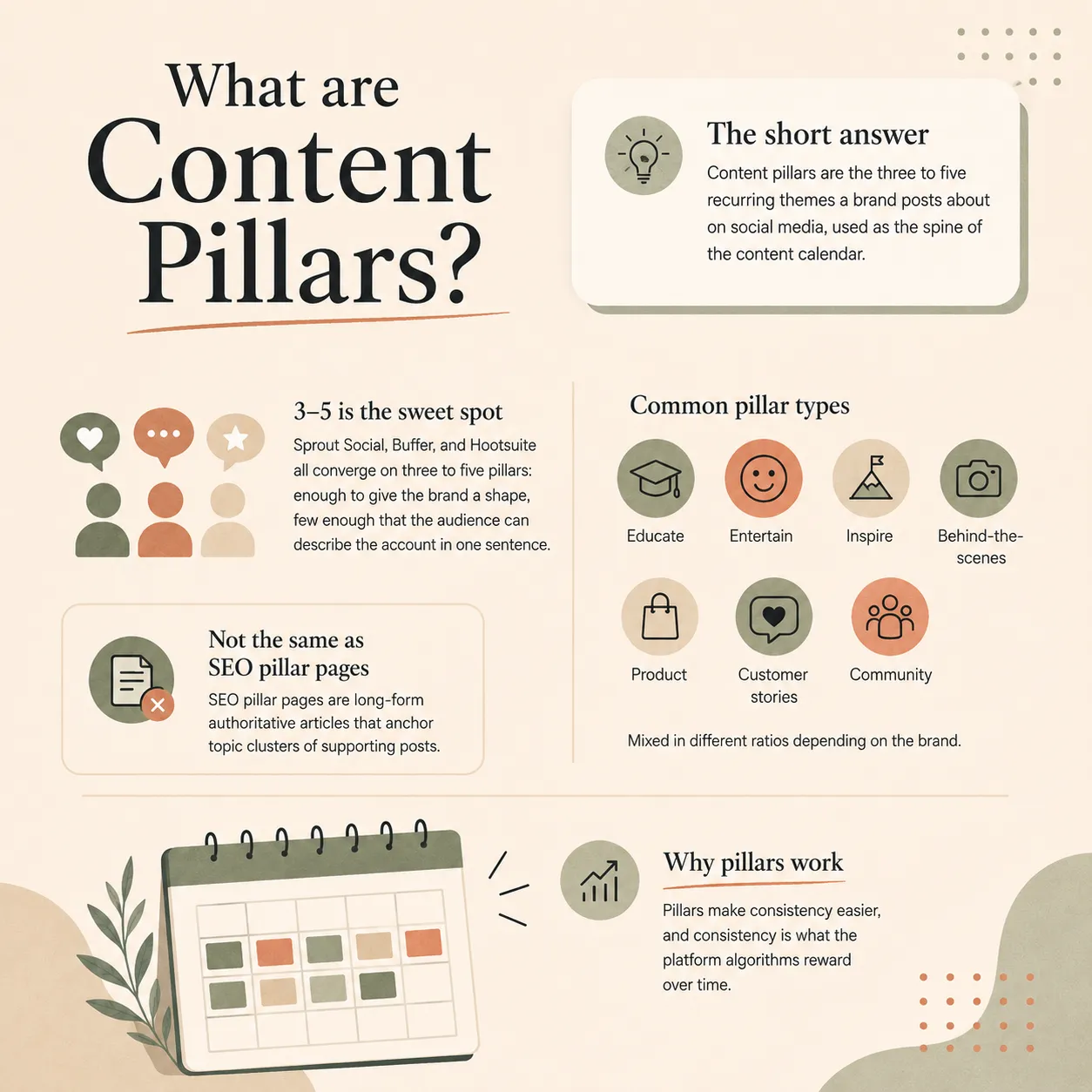
Content pillars are the three to five recurring themes a brand posts about on social media, used as the spine of the content calendar so every post has a home, the audience knows what the account is about, and planning stops being a blank-page exercise every week.
What are content pillars?
A content pillar is a theme the brand posts about often enough that the audience would name it if you asked them what the account is for. A skincare brand whose pillars are skin science, product, real routines, and behind-the-scenes ends up with an account that someone can describe in a sentence. The same brand without pillars ends up with an account that posts whatever crossed the social manager's desk that week, which in practice means three Reels of trends, a flat-lay, an out-of-office carousel, and the audience never quite working out what the feed is about.
Sprout Social defines them as "the key themes or content types brands consistently create and share across their social profiles, each aligning to a specific purpose, audience, or format", and Buffer's glossary entry for content pillars lands almost word for word in the same place. The exact wording varies, the substance does not: a small set of repeating themes, held over time, that gives the rest of the strategy a shape.
Three to five pillars is the consensus number across every sensible guide on the topic. Buffer's practical guide to content pillars for social media and Hootsuite's content planning guide both land on the same range, with the same caveat: fewer than three is repetitive, more than five is unfocused, and most brands settle around four after a quarter or two of running the system in real life.
Why do content pillars matter?
The honest reason is that running social without pillars is exhausting. Every Monday morning starts with the same blank calendar, the same meeting where someone asks "what should we post this week", and the same mid-week panic when the only idea on the board is a flat-lay of last quarter's product. Pillars fix the problem upstream by making the answer to "what should we post" a question of which slot in the rotation comes next, not what the team can think of in twenty minutes.
The audience-facing reason is recognition. A brand whose pillars are clear ends up with an account a stranger can describe in one sentence after thirty seconds of scrolling. A brand without pillars ends up with an account that looks like four different people are running it, which is usually because four different people are.
The platform-facing reason is consistency. Every major recommendation system (Instagram's, TikTok's, YouTube's, LinkedIn's) leans on signals about the audience's repeat engagement: do the same people come back and watch, save, share, comment again. Content pillars do not earn the reach directly, they make the consistency that earns the reach much easier to hold. See the algorithm entry for the longer version of why the platforms reward steady themes over scattershot posting.
Common types of content pillars
The pillars below are the ones that show up across almost every brand on social, in different combinations and ratios. Most brands pick three or four of these and ignore the rest.
Educate
Teach the audience something they did not know and probably came to the account to learn. How-to videos, explainer carousels, myth-busting reels, frameworks, comparisons, the kind of post a viewer saves to come back to. Almost every brand has at least one educate pillar, and most accounts where it is missing feel thinner than they should.
Entertain
Posts whose first job is to be enjoyable to watch. Memes inside the niche, trend-jacking, lighthearted behind-the-scenes, jokes the audience will tag a friend in. Entertain pillars carry the reach piece of the calendar because they get shared, and a brand without one tends to grow much more slowly than the educate-only version of itself.
Inspire
Customer transformations, founder stories, results from real users, the milestone post for a small win the team is proud of. Inspire pillars are what convert a casual follower into someone who actually believes the brand is good at what it does. They do not need to land every week, they need to be unmistakable when they do.
Behind-the-scenes
The kitchen, the studio, the warehouse, the founders, the team. The pillar that makes the brand feel like a place real humans work, which on social is closer to the centre of the strategy than most brands give it credit for. A behind-the-scenes pillar is the cheapest and most reliable trust-builder on the calendar.
Product
What the brand actually sells. New launches, deep dives on a specific product, comparisons inside the range, the answers to the questions support gets every week. Product pillars are easy to overdo and easy to underdo. The right ratio is whatever the audience will tolerate before the unfollow rate starts ticking up.
Customer or community
User-generated content, customer takeovers, regulars from the brand-owned community, reviews, the small group of people who would post about the brand whether they were paid to or not. A community pillar is the one most brands underrun, and it is also one of the highest-trust signals to a new viewer.
Industry take
What the brand thinks about something happening in the wider category. Strong opinions on a competitor's launch, a hot-take Reel about a trend the team disagrees with, a deep dive on a story the audience already cares about. Industry-take pillars are how brands get cited rather than just seen.
The wider field calls these the same set of names with small variations: Cloud Campaign and Sprout Social both group them into educational, inspirational, entertaining, promotional, and community, and the rest of the field follows. The label is less important than the rotation: pick the four that the brand can actually sustain, and ignore the names of the rest.
Content pillar examples by niche
The pillars look different in practice depending on what the brand sells. A few realistic combinations, drawn from how accounts in each space actually run.
Skincare brand
Educate (how skin works, ingredient explainers), product (the range, application demos), routines (real customer-shared routines), and behind-the-scenes (the lab, formulation choices, founder takes). The educate pillar carries the saves, the routine pillar carries the trust, and the product pillar pays the bills.
Restaurant
Menu (what is on this week, dish-by-dish), team (the chef, the front-of-house regulars, the dishwasher who has been there ten years), neighbourhood (the suppliers, the street, the regulars), and seasonality (the menu changes, the festivals, the slow week in February). A restaurant without a team pillar feels like a chain even when it is not.
B2B SaaS
Customer wins (the case studies, the metric improvements, the quote-card carousels), product education (the explainer videos for new features, the workflows), industry takes (the founder's opinion on a category trend), and recruiting (the team, the office, the why-we-built-this stories). The recruiting pillar is the one most B2B accounts skip and the one that quietly compounds the most.
Creator or coach
Educate (frameworks, lessons, free tactics), proof (the results from clients or from the creator's own work), personality (the unfiltered take, the daily routine, the studio), and offer (the product or service, with a link). A creator account that runs on one or two of these pillars usually grows faster early and plateaus harder later.
Real estate agent
Listings (the new homes for sale), neighbourhood (the schools, the cafes, the local context buyers actually want), education (mortgage tips, market updates, what closing costs cover), and personal (the agent themselves, the team, the deals that closed). A real estate account without a neighbourhood pillar reads like a brochure.
Fashion brand
Product (the drop, the lookbook, the campaign), styling (how to wear the piece, real-customer flat-lays), trend (what the brand thinks about the season), and behind-the-scenes (the design process, the factory, the team). A fashion account where the styling pillar is missing tends to over-rely on paid reach.
The point of the niche-specific examples is not that they are the right pillars for every brand in that space, it is that the rotation should sound specific to the business. A pillar set that reads "educate, entertain, inspire, sell" could belong to any brand on the internet, and that is usually a sign the team has not done the work of translating the framework into a real calendar yet.
How to choose your own content pillars
Two halves to the work: figure out what the audience and the business need from the account, then pick the smallest number of pillars that cover both without overlapping.
- Write down the ten topics the brand could plausibly post about. The list is usually a mix of product, expertise, customer stories, the wider category, and the personality of the team. Aim for ten before you start filtering.
- Ask which of the ten the audience actually came for. The DMs, the comments, the saved posts, and the questions support gets every week are the honest answer. The topics the team thinks the audience cares about and the topics the audience actually does care about are usually different.
- Ask which of the ten the brand can sustainably produce. A pillar that needs studio time every week is not a pillar if the team only books the studio twice a quarter. The right pillars are the ones the brand can actually keep publishing on, not the ones that look great on a slide.
- Ask which of the ten serve the business goal. A pillar that earns reach but never sells anything is fine as long as another pillar carries the conversion. A pillar set with no conversion lever in it is a hobby, not a strategy.
- Pick the smallest set that covers all three. Three pillars if the brand is small and the team is one person, four if there are two or three people on social, five at the outside. Resist the urge to add a sixth.
- Write a one-line description of each pillar. The description is the test the team will use to argue about whether a draft post belongs in the pillar or not. "Educate" on its own is too vague to settle the argument; "weekly explainer of one ingredient our formulator obsesses over" is specific enough that the team can agree.
- Set a rough rotation and run it for a quarter. Three months of posting against the rotation is the shortest honest read on whether the pillars are right. After a quarter the data shows which pillars are doing work and which are filling space, and the rotation can be adjusted.
Content pillars vs SEO pillar pages
The same words mean two different things depending on who is using them, and a fair share of the confusion in the SERP comes from the overlap.
On the social side, a content pillar is a recurring theme the brand posts about. On the SEO side, a pillar page is a long-form authoritative article that anchors a topic cluster of supporting blog posts. The HubSpot definition of a pillar page is "the basis on which a topic cluster is built. A pillar page covers all aspects of the topic on a single page, with room for more in-depth reporting in more detailed cluster blog posts that hyperlink back to the pillar page". The two ideas overlap in spirit (both organise content around a small number of anchor topics) and they get used interchangeably by people who have only met one of them.
For a social media glossary the social-side meaning is the one that matters, but the overlap is worth knowing because the same brand often runs both: a social calendar built around three to five social pillars, and a blog built around two or three SEO pillar pages with cluster posts feeding into them. The two systems do different jobs and rarely fight if they are scoped clearly.
Common content pillar mistakes
The mistakes below are what almost every brand learns the first time it tries to run a real pillar system, usually after a quarter of mediocre data.
- Pillars too vague to settle an argument. "Educate" is not a pillar, it is a category. "Weekly ingredient explainer for our formulator obsessions" is a pillar. The test is whether the team can use the description to decide whether a draft post belongs.
- Too many pillars. Six or seven pillars is a sign the team has not yet had the difficult conversation about what to drop. The calendar reads as scattered, the audience cannot describe the account, and the data never gets long enough on any one pillar to learn from.
- Pillars chosen for the team, not the audience. A pillar that the team enjoys producing but the audience does not engage with should be cut after a quarter at the latest. Ego pillars feel good and quietly drag the account's reach down month after month.
- No conversion pillar. A calendar that is all educate, entertain, and inspire and has no clear path to a sale is a content hobby. Even at one post a week, the conversion pillar has to be there or social stays a cost centre.
- Setting and forgetting. Pillars need a quarterly review. The data after twelve weeks usually shows one pillar overperforming, one underperforming, and the rest holding steady. The teams that ship the underperformer and double down on the winner are the ones whose accounts compound.
- Confusing pillars with formats. Reels, carousels, and stories are formats, not pillars. The same pillar should appear in multiple formats over a month, and the same format should appear across multiple pillars. Mixing the two leads to a calendar built around "Reels Tuesday" rather than around what the account is actually about.
- Treating the pillar set as branding rather than planning. Pillars are a working tool for the calendar, not a slide for the brand book. The right test is whether the team can use them on a Monday morning to decide what gets drafted, not whether they look good in a deck.
For the wider strategy context around pillars, the content batching entry covers the production side of running a pillar rotation, the caption entry covers the post-level craft, and the brand awareness entry covers what the pillars are quietly building over the long run.
Content pillars FAQ
How many content pillars should you have?
Three to five is the sweet spot most teams settle into. Two pillars get repetitive fast, six or more dilute the brand and make the content calendar feel like a rummage drawer. Sprout Social, Buffer, and Hootsuite all land on the same three-to-five range, and the small variation (some brands run on three, some on five) usually comes down to how many platforms the team is posting to.
What is the difference between content pillars and pillar pages?
A content pillar in social media is a recurring theme the brand posts about (educate, entertain, inspire, sell). A pillar page in SEO is a long-form authoritative article that anchors a topic cluster of supporting blog posts. Same word, two different jobs. The two ideas overlap in spirit (both organise content around a small number of anchor topics) and confuse a lot of people in practice. If the conversation is about Instagram, TikTok, or LinkedIn posts, the social meaning is the right one. If the conversation is about SEO, organic search, or HubSpot, the pillar-page meaning is the right one.
What are some examples of content pillars?
A skincare brand might run pillars of educate (how skin works), product (the range), routine (real customer routines), and behind-the-scenes (the lab, the founders). A restaurant might run on the menu, the team, regulars, and the neighbourhood. A B2B SaaS company often runs on customer wins, product education, industry takes, and recruiting. The shape is always the same: three or four themes broad enough to keep producing, narrow enough that the audience can describe what the account is about in one sentence.
Do content pillars help with the Instagram algorithm?
Indirectly. The Instagram ranking system favours accounts whose audience consistently engages with their posts, and content pillars make consistency much easier. A clear pillar set means the audience knows what kind of content to expect, the algorithm sees stronger watch and save signals because the right people are seeing the right posts, and the account gets categorised more cleanly for recommendation. The pillars do not earn the reach directly; the consistency they enable does.
How often should you revisit content pillars?
Once a quarter is enough for most brands. The full rewrite (replacing a pillar, dropping one, adding a new one) usually waits for a real reason: a product line launch, a strategy shift, a clear pattern in the data showing one pillar is doing all the heavy lifting and another is dead weight. Smaller adjustments (rotating the mix, retiring a recurring format inside a pillar) happen more often, ideally during the monthly content review.