Brand awareness is the share of your target audience who can recall or recognise your brand, measured through surveys and through behavioural signals like branded search volume, direct site traffic, social mentions, and reach on the posts that name the brand.
What is brand awareness?
Brand awareness is the part of marketing that decides whether your name is in the room when a buyer is making a decision. It covers two connected ideas. The first is whether people can recognise your brand when they see the logo, the name, or the colours sitting next to other options. The second is whether they can recall your brand from memory when the category comes up, without anyone showing them a list.
The reason this matters is that almost nobody buys from a brand they have never heard of. Awareness is the wide top of the marketing funnel, and every consideration, comparison, and purchase step depends on it. A buyer who has seen the brand five times across a year is more open to the sales page than a buyer who has seen it once. Awareness is the quiet work that makes later marketing cheaper.
The standard reference here is the academic definition of brand awareness, which has been measured the same way in marketing research for decades: the extent to which customers are able to recall or recognise a brand under different conditions. The mechanics have not changed. Only the channels have.
Brand awareness vs brand recognition vs brand recall
These three terms get used as if they mean the same thing, and the confusion is the reason a lot of awareness work gets measured badly. Brand awareness is the umbrella. Recognition and recall sit underneath it, and they are different jobs.
Brand awareness
The parent concept. How familiar your target audience is with your brand, including both passive recognition and active recall. Awareness is what you are trying to grow.
Brand recognition (aided)
Whether someone can identify your brand when they see the logo, name, colours, or jingle. Recognition is the easier of the two, and most categories have many brands sitting in this layer with shoppers who know them but rarely think of them first.
Brand recall (unaided)
Whether someone can name your brand from memory when prompted only by the category, with no logo or list. Recall is harder than recognition, and the gap between the two is roughly where most awareness budgets are aimed.
Top-of-mind awareness
The strongest version of recall. The first brand a buyer names in a category, before any others. Most categories have two or three brands at this level, and the financial gap between top-of-mind and the rest is large.
A useful way to think about the difference: recognition is the lineup question, recall is the open-ended question. If a survey shows the logos of five brands and asks which ones the respondent knows, that measures recognition. If the survey asks which scheduling tools the respondent can name, with no list, that measures recall.
What are the types of brand awareness?
Most marketing teams group brand awareness into a small set of layers, which the research literature has used for decades and which still maps cleanly onto social media work.
Aided awareness
Measured by showing the respondent the brand name or logo and asking whether they have heard of it. It tells you how wide your reach has been historically. A brand can have very high aided awareness while still being weak at recall.
Unaided awareness
Measured by asking the respondent to name the brands they know in a category, with no list shown. This is the harder, more meaningful number, because the brand has to surface from memory on its own.
Top-of-mind awareness
A subset of unaided awareness. The percentage of respondents who name your brand first when asked about the category. Top-of-mind is the layer where buying defaults live, which is why incumbent brands spend so much defending it.
Brand salience
A related concept, often used by Byron Sharp and the Ehrenberg-Bass school. Salience is how easily the brand comes to mind across the wide range of situations where it could be relevant, rather than just in one survey moment.
These layers stack. A buyer can recognise the brand without recalling it, and recall it in some categories but not others. Strong brand work is the work of moving people up the stack, from never heard of it, to recognise it, to remember it, to think of it first.
How do you measure brand awareness on social media?
Brand awareness on social media is measured with two kinds of evidence. Survey work tells you what people remember. Behavioural signals tell you what that memory looks like in the data. The honest version of measurement uses both, because either one on its own is easy to mistread.
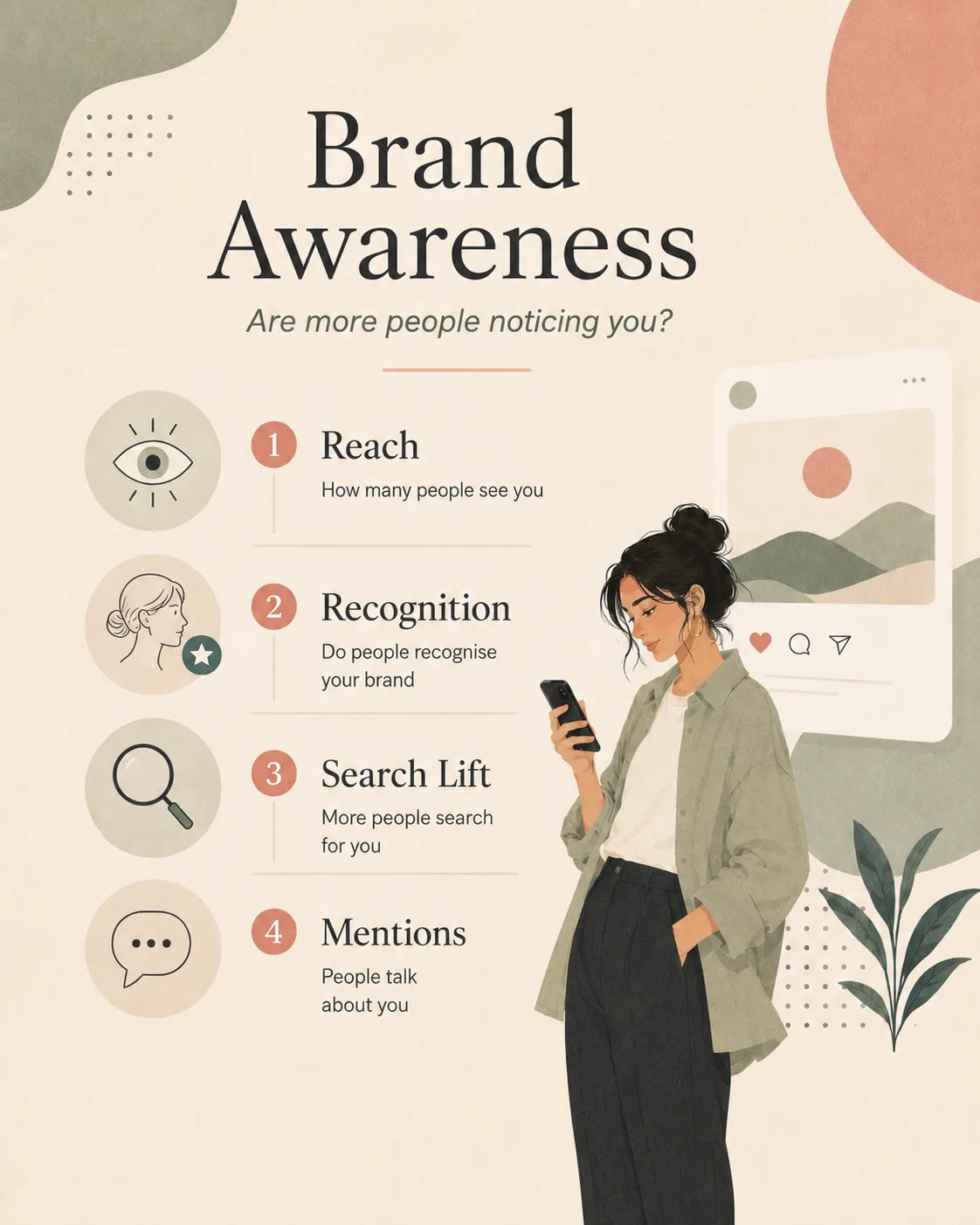
Reach and impressions
Reach is the number of unique accounts who saw a post. Impressions is the total number of times it was shown. Reach is the cleaner awareness signal of the two, especially when compared against a stable account baseline rather than treated as a one-off number.
Video views and watch time
On TikTok, Reels, and YouTube, video views and three-second to thirty-second view rates are the most reliable awareness signals you can pull from the platform itself. Long watch time on short-form is a sharper signal than impressions alone.
Estimated ad recall lift
Meta reports estimated ad recall lift on the awareness objective in Ads Manager, which estimates the number of people likely to remember seeing the ad within two days. It is a model, not a survey, but it is the closest in-platform proxy for recall most advertisers will see.
Brand mentions and share of voice
Brand mentions are every post, comment, or reply that names your brand, with or without a tag. Share of voice compares that volume against the named competitors in your category. Share of voice is one of the few awareness numbers that is hard to inflate with ad spend alone.
Branded search volume
How many people search your brand name on Google, YouTube, or TikTok in a given month. A steady rise in branded search is one of the strongest awareness signals you can track, because the buyer had to remember the name to type it.
Direct site traffic
Direct visits are people who typed the URL or used a bookmark. Sustained growth in direct traffic, separated from referral and paid, points to a brand that is sticking in memory rather than being clicked on once and forgotten.
Aided and unaided survey questions
The most reliable awareness number still comes from asking. A short tracking survey, run quarterly to a representative sample of the target audience, with one aided question and one unaided question, gives you the ground truth that platform data can never quite match.
Pull these together in one place rather than reading each metric in isolation. A spike in reach with no rise in branded search usually means a viral moment that did not convert into memory. A rise in branded search with flat social reach usually means the awareness was built off-platform, often through partnerships, press, or word of mouth.
How do you build brand awareness on social media?
Most brand awareness on social media is built with the same handful of levers, repeated across months. The mistake is treating the work as a list of clever campaigns rather than a habit of distinctive, consistent posting that people can actually remember.
Distinctive brand assets
A logo, a wordmark, a colour, a tone of voice, a recurring character, a recurring format. Pick assets that survive being shrunk to a profile picture or a five-second video frame, then use them on everything. Awareness compounds when the audience can identify the brand in half a second.
Consistent posting cadence
Awareness is the result of being present, not present in one burst. A steady cadence beats a sporadic flurry, which is the whole argument for content batching across platforms.
Format-native creative
What works on TikTok rarely works on LinkedIn, and what works on Reels rarely lands word-for-word on X. Awareness work is more efficient when the post belongs to the format it lives in, not when one piece of creative is reposted everywhere without edits.
Awareness-objective ads
Paid awareness pushes the brand into rooms organic reach has not touched. Meta runs this under the Awareness objective in Ads Manager, and LinkedIn does the same through the Brand Awareness ad objective, both optimised for reach or estimated recall rather than clicks.
Boosted strong organic posts
When an organic post is already earning saves, shares, and comments, a small boosted post on top of it is one of the cheaper ways to grow awareness, because the platform is already telling you the creative resonates.
Partnerships and collaborations
Creator partnerships, cross-posts, podcast appearances, and joint launches put the brand in front of audiences that would have taken years to grow from scratch. The audience trust transfers with the partner.
PR and earned moments
An interview, a feature, an industry award, or a thoughtful piece of research that other outlets quote. Earned coverage adds a layer of awareness that paid spend cannot quite buy, because the audience hears about the brand from someone other than the brand.
None of these levers work on their own. A brand that posts daily but has no distinctive look gets reach without recall. A brand with a beautiful identity that posts every six weeks gets the recognition of the people who already follow and not much else. The pattern that actually grows awareness is a small set of distinctive assets, repeated often, across the formats where the target audience is paying attention.
What mistakes should you avoid when building brand awareness?
Brand awareness work fails in predictable ways. The pattern is almost always the same: a team that wants long-term memory growth, measured against short-term performance metrics, with creative that has nothing consistent for the audience to remember.
Treating awareness like a one-off campaign
A single push, a hero video, a launch week. The reach spike feels good and then fades. Awareness is the kind of marketing that lives or dies on repetition, and a brand that runs awareness as one project a year almost always ends up starting from scratch the next year.
Measuring awareness with click metrics
Awareness ads judged on click-through rate or cost per click will always look worse than performance ads, because they are not built for clicks. The right metrics are reach, video views, estimated recall lift, branded search, mentions, and direct traffic.
Changing the look every quarter
A new colour, a new mascot, a redesigned wordmark, a different photography style every six months. Audiences need pattern recognition more than they need novelty, and constant refreshes reset the awareness work the brand has already paid for.
Targeting too narrowly
Awareness needs to reach future buyers, not only the current ones. Targeting only existing customers or a tight retargeting pool grows the wrong layer of the funnel. The audience for awareness work should be wider than the audience for performance work.
Ignoring the algorithm side of distribution
Strong creative still has to get out of the post drafts and into feeds, which is mostly a function of how each platform's ranking system reads the post. The social media algorithm page covers what these systems look at and how to give them what they want.
Reading platform metrics in isolation
A jump in Reels reach with no movement in branded search is rarely the win it looks like. Pull awareness numbers into one social media analytics view so the team can tell a memory signal from a one-day spike.
Brand awareness FAQ
What is brand awareness in simple terms?
Brand awareness is how many of the right people know your brand exists, and how easily they can pull it from memory when they need what you sell. If someone hears the category and your name shows up in their head without help, that is brand awareness doing its job.
What is the difference between brand awareness and brand recognition?
Brand awareness is the wider idea, covering both recall and recognition. Brand recognition is the narrower one, sitting under awareness, and it specifically measures whether someone can pick your brand out of a lineup when shown the logo, colours, or name. Awareness is the parent term, recognition is one piece of it.
How do you measure brand awareness?
Combine survey work (aided and unaided recall questions) with behavioural signals (branded search volume, direct site traffic, social mentions, share of voice, and reach on social posts). The survey side tells you how many people remember the brand. The behavioural side shows whether that memory turns into action.
Is brand awareness the same as followers?
No. Followers are people who chose to subscribe to your account. Brand awareness includes those followers and everyone else who has heard of the brand, seen its content, or recognises the name, even if they have never tapped Follow. A small account can have outsized awareness, and a large account can still have weak recall outside its niche.
What are some examples of brand awareness campaigns?
Classic examples include Coca-Cola's Share a Coke, Volvo Trucks' Epic Split with Jean-Claude Van Damme, and Dove's Real Beauty Sketches. Each one used a single distinctive idea, repeated across paid and organic channels, with a metric like reach, lift in branded search, or estimated ad recall that the team was willing to be judged on.