A social media campaign is a coordinated set of posts, ads, and other social activity, organised around one goal, one audience, and one defined start and end date, so the result can actually be measured.
What is a social media campaign?
A social media campaign is the thing you do when an account needs to move a specific number, by a specific date, for a specific reason. Every asset in the campaign points at the same goal. The posts share a theme or hero idea, the ads support it, and the dates carry a clear beginning and end so the result can be compared to a baseline.
A campaign usually runs across one or more platforms, often pairs organic content with paid promotion, and lives inside a budget that somebody signed off. The work behind it sits in three places: the creative (the posts and ads themselves), the distribution (where and when they go out), and the measurement (the KPIs and the person who owns them).
The clearest way to spot a campaign is the timeline. Always-on posting has no real end date. A campaign has a launch day, a peak window, and a wind-down. Everything inside that timeline is tied back to what the campaign was trying to do.
How is a campaign different from regular posting?
Both feed the same accounts, but they do different jobs. Regular posting keeps the brand present. A campaign concentrates the brand on one outcome for a window of time.
Time horizon
Always-on posting is rolling and indefinite. A campaign has a start, a peak, and a stop. The end date is the whole reason you can measure it as a campaign at all.
Number of goals
Always-on accounts juggle several goals at once, like brand voice, audience engagement, and customer service. A campaign picks one of those goals and ignores the rest until the campaign closes.
Asset planning
Always-on content tends to be planned post by post or week by week. A campaign is planned as a whole arc, with a teaser, a hero asset, supporting posts, and follow-up content all designed together before launch.
Budget shape
Always-on spending is usually a flat monthly line. Campaign spending is a curve, with most of the budget concentrated in the launch and peak phases and a smaller tail for retargeting and proof-of-result content.
Reporting
Always-on reports compare months against each other. Campaign reports compare the campaign window against the baseline of normal activity, so the team can isolate what the campaign actually added.
Strong social accounts use both. Always-on posting holds the audience between campaigns, and campaigns concentrate effort at the moments when a specific outcome matters more than usual: a launch, a sale, a season, a relaunch, or an awareness push tied to a real-world event.
What are the main types of social media campaigns?
Most campaigns fall into one of a handful of shapes, and the shape decides almost everything else: the timeline, the platforms, the creative, the spend, and the metrics.
Product launch campaign
A coordinated push around a new product, feature, or collection. Usually has a teaser phase before launch, a hero day, and a few weeks of supporting content. Measured on launch-day sales, week-one revenue, and the lift in branded search and product page visits.
Brand awareness campaign
Built to grow the percentage of the target audience who know the brand exists and can recall it. Tracked through reach, video views, mentions, and lift in branded search. The brand awareness glossary entry covers the measurement side in more depth.
Lead generation campaign
Designed to capture form fills, demo requests, sign-ups, or messages, usually with a gated asset or an offer. Most often paired with paid lead-form ads on Meta or LinkedIn, and measured on cost per lead, lead quality, and downstream pipeline.
Sales and conversion campaign
Pointed at revenue, with discount codes, time-limited offers, retargeting, and a tight catalogue or landing page. Measured on conversions, cost per acquisition, average order value, and return on ad spend.
User-generated content (UGC) and contest campaign
Asks the audience to make something with the brand, usually with a hashtag, a prompt, or a prize. Measured on entries, mentions, hashtag reach, and the volume of usable content the campaign produces.
Influencer and creator-led campaign
Built around one or more creators making content on behalf of the brand. Measured on creator engagement rate, video views, branded search lift, and direct conversions through trackable links or codes.
Seasonal and holiday campaign
Tied to a calendar moment like Black Friday, end-of-financial-year, Mother's Day, or back-to-school. Measured on year-over-year performance against the same period and on share of voice during the seasonal window.
Reactive or moment-driven campaign
Short, opportunistic, often built in days rather than weeks, around a news cycle or cultural moment that fits the brand. Measured on reach, share rate, and earned coverage rather than direct conversions.
Most real-world campaigns are blends. A product launch usually carries an awareness arc and a conversion arc inside the same timeline. The useful thing the type tells you is which metric to lead with and which ones to treat as supporting evidence.
How do you plan a social media campaign?
Most campaign planning collapses into a one-page brief and a calendar. Everything else is either creative production or distribution work that sits inside those two artefacts.
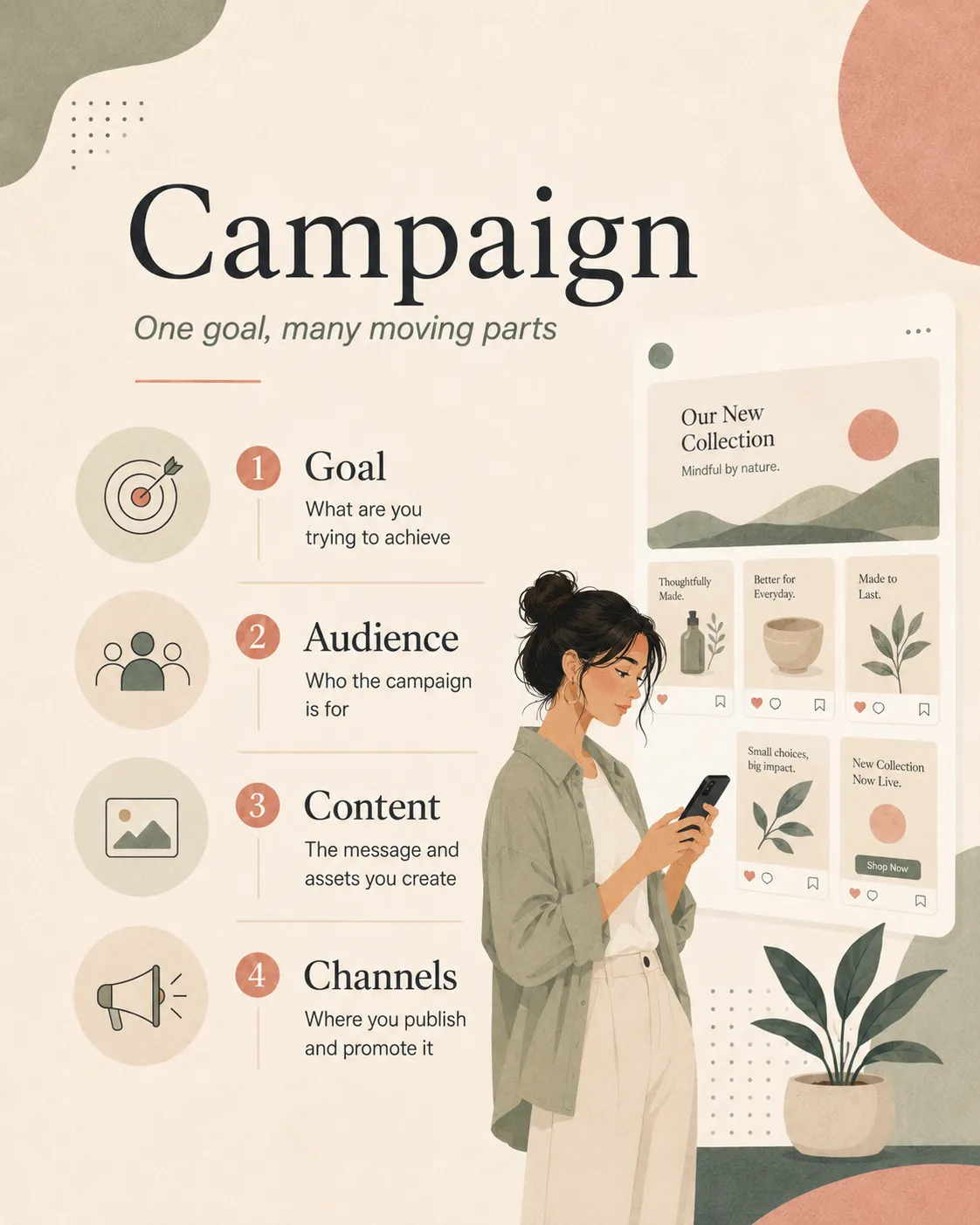
- Name the goal. One sentence. Sell, sign up, follow, remember. A campaign with two top-line goals usually ends with two half-done campaigns.
- Define the audience. Who you are trying to reach, where they spend their time, and what they already know about the brand. The audience answers most of the platform and creative questions for you.
- Pick the platforms. Run on the platforms where the audience actually is, not the ones the team is most comfortable with. Two platforms done well beat five done in passing.
- Set the dates and the budget. Hard start date, hard end date, and the spend you are willing to lose if the campaign returns nothing.
- Choose the hero asset. One piece of creative that everything else supports. A video, a single image set, a launch page, or a story format. Without a hero, the campaign collapses into loose posts.
- Plan the calendar. Map every post, story, and ad to a date and platform, including the teaser, the launch day, the midweek reminders, and the closing push.
- Pick the KPIs. Two or three numbers, no more. The ones the team is willing to be judged on, defined before the first post goes out.
- Name the owner. One person who is responsible for the campaign result. Most campaigns drift because the ownership is shared instead of held.
On the paid side, the platform you spend on decides the campaign objective screen you will live in. Meta runs campaigns through the campaign objectives in Ads Manager (awareness, traffic, engagement, leads, app promotion, sales), and LinkedIn does the same through its marketing objectives in Campaign Manager. Picking the wrong objective is one of the more expensive ways to weaken an otherwise good campaign, because the algorithm optimises toward whatever you told it to.
The other half of planning is removing friction. Every campaign carries invisible work like approvals, asset hand-offs, link tracking, and pixel checks. The teams that run good campaigns build that infrastructure once and reuse it, so every campaign after the first starts from a higher floor.
How do you measure social media campaign success?
Campaign measurement starts before the campaign goes live. Without a baseline of normal activity and an agreed KPI, the post-campaign report turns into a dashboard of numbers that nobody can interpret.
Awareness KPIs
Reach, impressions, video views, three-second to thirty-second view rates, estimated ad recall lift, mentions, share of voice, and branded search lift. Used when the campaign goal is to grow the audience that knows the brand.
Engagement KPIs
Likes, comments, shares, saves, replies, profile visits, and engagement rate. Useful as supporting signals for almost any campaign, and as headline KPIs for content-led pushes built to drive conversation.
Traffic KPIs
Link clicks, click-through rate, sessions in the campaign window, time on the landing page, and bounce rate. Most useful when the post or ad sends the audience to a long-form destination.
Conversion KPIs
Leads, sign-ups, sales, revenue, cost per lead, cost per acquisition, and return on ad spend. The numbers the finance side of the business actually cares about, and the headline KPIs for any conversion-led campaign.
Brand-side KPIs
Sentiment, share of conversation, follower growth attributable to the campaign window, and lift in surveyed awareness or favourability. These take longer to measure but tell you whether the campaign added something the next campaign can build on.
The report itself is the part most teams skip. A useful campaign wrap-up names the goal, shows the result against the baseline, explains what worked, names what did not, and writes down the two or three things the next campaign will change. Without that document, the team learns nothing it can carry forward. Pulling the numbers together is easier when the social media analytics for every platform live in one place rather than in seven different dashboards.
What mistakes should you avoid with social media campaigns?
Failed campaigns mostly fail for the same reasons, and the warning signs show up in the brief long before the first post goes out.
Two top-line goals
Awareness and conversion treated as equal priorities inside one campaign. The creative ends up trying to do both, the platform algorithm gets a mixed signal, and the report cannot honestly say which one moved.
Too many platforms
A campaign that runs on six platforms with the same asset reposted everywhere usually performs worse than a campaign on two platforms with creative built for each format. Spread is not strategy.
No hero asset
Without a single piece of creative the rest supports, the campaign feels like a stream of related posts rather than a campaign. The audience needs something to anchor on.
Launching without a baseline
If nobody recorded how the account was performing before the campaign, nobody can prove what the campaign added. Take a baseline snapshot in the week before launch.
Boosting weak campaign posts
Putting money behind a post the audience already ignored does not save the campaign. The boosted post glossary entry covers why spend amplifies what the post is, not what you wished it was.
Ignoring the wind-down
Most campaigns get planned up to launch day and then trail off. The two weeks after peak are usually where the long-tail traffic, the social proof posts, and the recap content do the quiet conversion work.
No campaign brief
A campaign that lives in someone's head rather than on a one-page brief drifts at every approval step. The brief is cheap and the rework it prevents is expensive.
Reporting in isolation
Reading the platform dashboards one by one hides the pattern. Pull the campaign window into a single view against the baseline so the result is one comparison, not seven.
Social media campaign FAQ
How long should a social media campaign run?
Most product launches and seasonal pushes run two to six weeks, with a short teaser phase, a peak phase around the announcement or sale, and a fade-out that re-uses the strongest assets. Awareness campaigns often run longer because memory needs repetition, while UGC and contest campaigns usually wrap in two to three weeks while the entries are still fresh.
How much does a social media campaign cost?
There is no single number. A small organic-led campaign with one paid boost might cost a few hundred dollars in spend plus the team's time. A multi-platform paid campaign with influencer fees, video production, and weeks of testing can run tens of thousands. The honest starting question is the budget that the business is willing to lose if the campaign returns nothing, then plan inside that ceiling.
What makes a successful social media campaign?
A single clear goal, a small set of distinctive assets, a calendar the team can actually hit, and a measurement plan written before the first post goes out. Campaigns that fail usually have either too many goals, too many platforms, or no honest definition of what success looks like.
What is a campaign brief?
A one-page document the team agrees on before the campaign starts. It names the goal, the audience, the platforms, the dates, the hero asset, the key message, the budget, the KPIs, and the person who owns the result. The brief is the artefact that turns a vague idea into a campaign someone can execute.
Can a small business run a social media campaign?
Yes, and small businesses often run sharper campaigns than larger ones, because the audience is narrower and the founder is closer to it. The trick is picking one platform where the buyer actually spends time, running a tight campaign for a few weeks, measuring honestly, and reusing what worked next time.