Evergreen content is content written once and useful to readers for years: how-to articles, beginner guides, glossaries, definitions, FAQs, comparisons, and other formats that are not tied to a news cycle, a specific date, or a season, and that keep earning traffic, links, and social shares long after the publish date.

What is evergreen content?
Evergreen content is the long-life half of a content library. Semrush's guide on evergreen content defines it as material that stays relevant over a long period and needs few updates to keep providing value, with the emphasis on core topics that rarely change. Buffer's glossary entry on evergreen content lands in the same place: anything you create for your site, blog, or social channels that holds sustained interest over time rather than spiking and fading inside a week.
The opposite category is topical content. Topical content is the news write-up, the product launch announcement, the seasonal gift guide, the live tournament recap, the response to the trending discourse. It earns most of its traffic in the first 24 to 72 hours and falls off a cliff after that. A healthy content library runs both, with evergreen carrying the long, slow baseline and topical providing the spikes that bring new readers in.
The economic argument for evergreen is that the cost of writing it is paid once, while the traffic it earns accumulates for years. Buffer cites a Parse.ly study showing that over half the top 100 sites in their network attribute more than five per cent of all page views to evergreen content. That five per cent is a steady, predictable lift sitting underneath every other initiative.
Where the name evergreen comes from
The name is a botany metaphor. Evergreen trees and shrubs (pines, firs, spruces, hollies, eucalyptus, most conifers and a large share of tropical plants) keep their leaves or needles through every season instead of shedding them in autumn the way deciduous trees do. The leaves are not literally permanent (each one falls eventually) but the tree never stands bare, because the loss is staggered across years rather than packed into one drop in October.
The metaphor carries over neatly. An evergreen blog post is not literally untouched forever; pieces of it (statistics, screenshots, citations, dates) need replacing on a rolling schedule. The page as a whole never falls bare. The term has been in steady use in content marketing since the mid-2000s and is the standard industry vocabulary for the long-life half of a content library now.
What makes a piece of content evergreen
Three things have to line up for a piece of content to actually earn evergreen traffic, and most of the false evergreen on the internet is a piece that has two of the three.
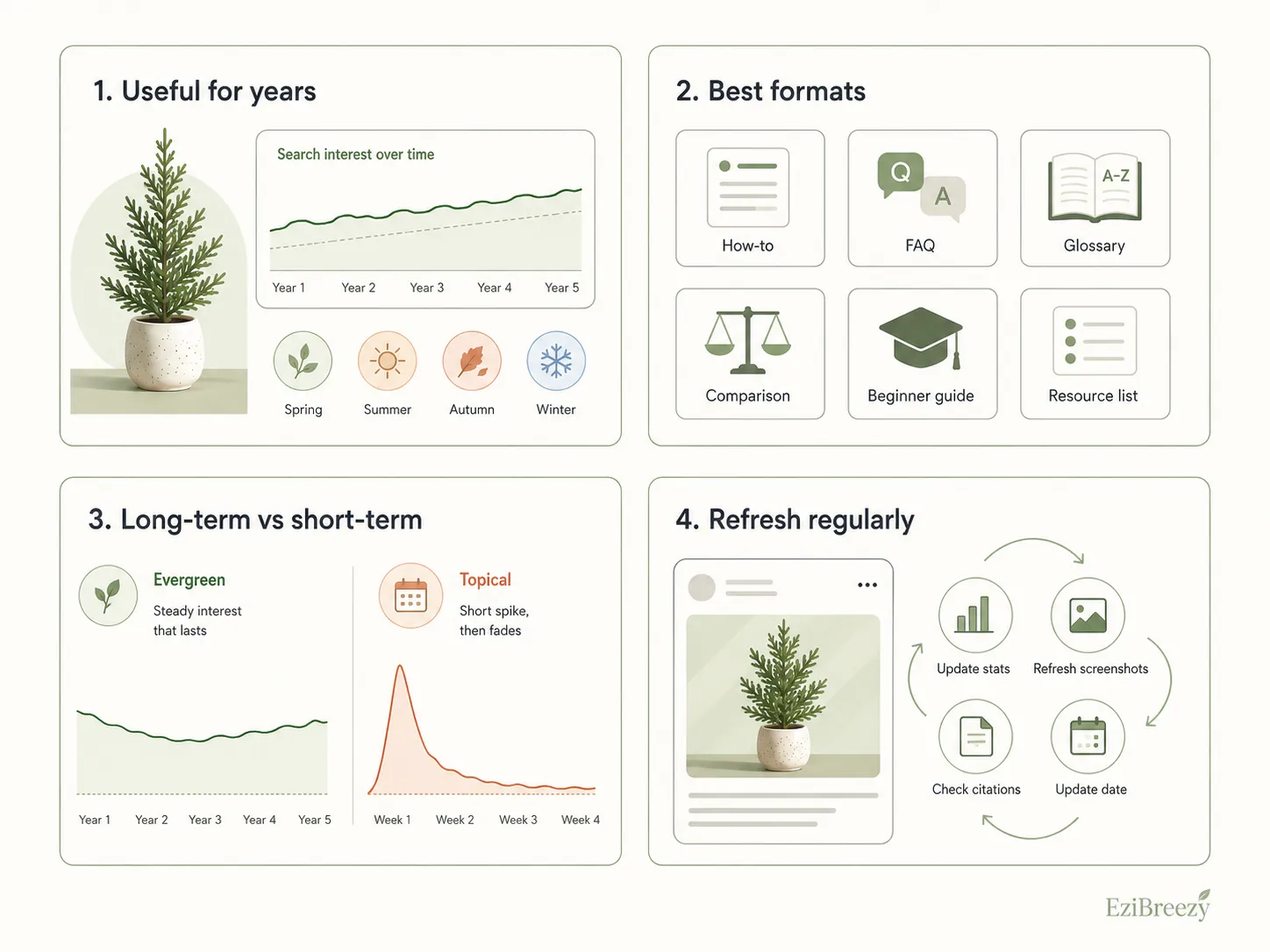
Steady search demand
Real people have to be searching for the topic month after month, year after year. The Google Trends graph for the underlying query has to look like a flat line or a gentle slope rather than a single tall spike. A piece on a topic nobody searches for is not evergreen, it is dormant.
Slow-changing subject matter
The information in the piece has to stay true for years rather than weeks. A how-to on cooking rice is evergreen; a how-to on a software setting that ships behind a feature flag is not. The faster the underlying domain moves, the harder evergreen is to write honestly without committing to constant updates.
No time-stamps baked into the writing
Phrases like "this year", "last week", "as of writing", and "the new" turn a piece into something that reads as out of date the moment time moves on. The fix is to phrase the writing so it stays correct without dating itself, and to update the explicit timestamps separately on a refresh.
The hidden fourth condition is that the topic has to be worth ranking for. An evergreen page on a query nobody searches for is a long-life article that gets ten visitors a month. The keyword research that produces a useful evergreen plan is the same research that drives the rest of the content strategy: pick topics with sustained, non-trivial search volume that the brand can credibly cover.
Evergreen content formats and examples
Some formats hold up over years almost without effort because the underlying intent does not change. Semrush's guide groups them into five families, and the Digital Marketing Institute's evergreen content guide and Buffer's longer guide to creating evergreen content land on a near-identical list.
How-to articles and tutorials
Step-by-step walkthroughs of a task or skill. The reader has the same problem this year and next year, the instructions stay roughly the same, and the page earns traffic on a steady drip for years. "How to start a podcast", "how to write a press release", "how to read a balance sheet".
Beginner and ultimate guides
The big foundational piece on a single topic, written for someone coming in cold. Pillar pages and ultimate guides sit at the centre of most content libraries because they consolidate intent and earn the kind of inbound links that compound for years.
What-is explainers and glossaries
Definition pages, glossary entries, and "what is X" pieces. The query is permanent, the answer barely changes, and the format converts well to AI-snippet and featured-snippet placements. The page you are reading now is one.
Comparison pieces
"X vs Y" pages where the two options exist for years. SaaS comparison pages, framework comparisons, methodology comparisons. Reliable evergreen traffic, with the caveat that one of the two options sometimes gets bought or renamed and the page needs editing.
Lists of resources, tools, and templates
Curated lists are evergreen if the underlying need is evergreen. "Best free invoicing tools for freelancers" works for years; "Best AI tools of 2024" does not. The rule is to keep the topic permanent and the list inside it updated rather than encoding the date in the title.
FAQs and definitions on industry terms
FAQ pages and acronym definitions answer questions the audience asks every month. Searchers landing on these pages also click around to the wider product or pillar pages at higher rates than they do from any topical post.
Free tools and calculators
An evergreen tool (a paycheck calculator, a font generator, a markdown previewer, a hashtag character counter) keeps earning links and traffic without writing a single new word. The maintenance is small and the inbound-link rate is usually the highest of any format on the site.
The deliberately-not-evergreen list is just as important. News write-ups, event recaps, opinion pieces tied to a specific incident, year-stamped roundups, holiday gift guides, and product launch announcements all have their place, but they earn most of their traffic inside a week and should never be the foundation of the content plan.
Evergreen content for SEO
Evergreen is the half of the SEO library that compounds. Topical posts spike and fade; evergreen pages accumulate backlinks, internal links, and traffic on a schedule that looks more like an interest curve than a news graph. The single biggest reason most SEO teams have moved the bulk of their effort to evergreen formats since the late 2010s is that the cost-per-organic-visit on a well-built evergreen piece, amortised over five years, is a fraction of the cost-per-visit on a topical post that earned its traffic in the first week and never again.
The complication is Google's Query Deserves Freshness signal, introduced by Amit Singhal in 2007 and rolled into the public freshness algorithm update on 3 November 2011. QDF decides, on a per-query basis, how heavily to weight recently updated pages against older ones. On a query about a current event, recency dominates and an evergreen piece from three years ago is going to sit below the news write-up published this morning. On a query about a stable topic ("what is compound interest", "how to tie a bowline"), the freshness signal is mostly off and the evergreen page wins on link strength and depth.
The practical effect is that the queries best suited to evergreen content are the queries where QDF is dormant. A five-year-old definition page can keep ranking at the top of Google for the underlying definition query indefinitely, provided the page is still accurate and the link graph around it is healthy. The same five-year-old page would not rank for "definition X in 2026" without an update, because that query is signalling freshness intent.
Evergreen content on social media
Social platforms split into two camps on whether evergreen actually works there. The feed-based networks (LinkedIn, X, the Facebook home feed) have a short organic half-life on any single post: forty-eight hours is the practical ceiling on a LinkedIn post and ninety minutes on an X post. Evergreen on those platforms is mostly a back-catalogue play, where the same idea is rewritten and reshared at different points through the year rather than a single post that keeps earning views forever.
The recommendation-fed platforms behave differently. Sendible's piece on evergreen social media content notes that TikTok, Reels, YouTube Shorts, and Pinterest all run on systems that pull older content forward whenever the algorithm decides a new slice of the audience is ready for it. A TikTok from eighteen months ago can pick up a hundred thousand views overnight if a new cohort starts watching the format; a Pinterest pin from 2021 is still earning saves now. That is genuine evergreen behaviour, not back-catalogue resharing.
The split matters for planning. On TikTok, Reels, and Shorts the work is in producing a back catalogue of educational and utility-led shorts that the algorithm can keep redistributing. On feed networks the work is in writing each post knowing it will fade, and queueing the evergreen ideas back into the calendar on a six-to-twelve week rotation rather than relying on the platform to surface them. The batching entry covers the production workflow that keeps both catalogues alive without burning out the team.
Updating and refreshing evergreen content
Evergreen is not the same as ignored. Most SEO guides converge on a refresh cadence of every six to twelve months on competitive pages and an annual audit on the rest. The refresh is small and structural: stats, screenshots, citations, product names, version numbers, broken links, anything that has drifted since the last edit. The bones of the piece stay the same.
Statistics and citations
Any number quoted from an external source has a half-life. Replace cited numbers with the latest published version, and replace dead citations with current ones from the same source where possible.
Screenshots and product names
Software UIs drift, products get renamed (Twitter to X, the platform formerly called Acorns), and screenshots from three releases ago look outdated to a reader who is looking at the current version on a second screen.
Internal and external links
A piece written in 2023 will have outbound links to pages that no longer exist by 2026 and inbound link opportunities to new pages on the same site that did not exist then. Fix the 404s, add the new internal links.
Headline keywords
The phrasing of search queries shifts over years. The piece that originally targeted "podcast hosting" might rank better in 2026 for "best podcast host platforms". A keyword refresh on H1 and H2 alone often moves a page noticeably without rewriting the body.
Update date on the page
Most CMSs let the publish date and the updated date both render on the page. Set the updated date when the refresh ships; Google's freshness systems read the structured-data date as one signal of recency.
The lead and the conclusion
The lead paragraph dates faster than the body because it tends to reference current context. The conclusion dates because of CTAs and links. Both deserve a closer look on every refresh than the middle of the piece.
The Hootsuite glossary entry on evergreen content makes the point that evergreen is not the same as set-and-forget, and that the brands that actually earn the compounding traffic are the ones with a recurring refresh slot on the calendar. A single afternoon a month spent updating older pieces tends to lift overall organic traffic more than writing one extra new post in the same time.
Common evergreen content mistakes
- Putting the year in the title."Best email marketing tools 2024" was evergreen until 1 January 2025. The fix is to leave the date out of the H1 and the slug, keep the content updated, and let Google read the refreshed update date instead.
- Phrases that age the writing. "Last week", "just announced", "as of writing", "in the latest update". Every one of these starts pointing the wrong direction the moment the calendar moves. Rephrase to a permanent tense and add a separate timestamp if recency really matters.
- Skipping the refresh entirely. A piece published in 2020 and never touched again is probably underperforming a competitor piece on the same topic that got a refresh in 2026. Half the SEO gains attributed to new content are actually gains that would have come from updating the old one.
- Treating topical content as if it were evergreen. The launch announcement, the conference recap, the news response. These pieces do their job in the first week and should be allowed to fade. Building the editorial calendar around them produces a graveyard of pages no one searches for any more.
- Treating evergreen content as if it were topical. The opposite mistake: writing the deep how-to in launch-week voice, packing it with references to current events, and tying it to a date stamp. The piece could have run for five years and is dead in eighteen months.
- Producing evergreen on a topic that has no organic search demand. A useful guide on a topic nobody is searching for is not evergreen, it is dormant. Keyword research before writing is the only way to tell which is which, and the difference between a guide that earns 50,000 visits over five years and one that earns 200 is almost entirely a keyword choice.
- Not reusing the evergreen back catalogue on social. A library of fifty evergreen blog posts is fifty short-form script ideas for captions, Reels, TikToks, and LinkedIn carousels. The brands that run evergreen well treat the blog and the social back-catalogue as one shared source rather than two unconnected pipelines.
For the wider context evergreen sits inside, the content pillars entry covers the planning layer the evergreen pieces should attach to, the batching entry covers the production workflow that produces both the evergreen and the topical posts, and the algorithm entry covers why TikTok and Reels treat older posts so differently from feed-based networks.
Evergreen content FAQ
What is evergreen content, with examples?
Evergreen content is anything written once and useful for years: a beginner's guide to a topic, a how-to walkthrough, a glossary entry, a definition, a checklist, a comparison piece, an FAQ. The opposite is topical content, which is tied to a specific date, news cycle, or season and stops earning traffic the moment the moment passes. Most healthy content libraries are a mix of both, with the evergreen pieces doing the long, slow traffic work and the topical pieces driving the short spikes.
Why is it called evergreen content?
The name comes from evergreen trees, the pines, firs, spruces, and hollies that keep their leaves through every season instead of shedding them in autumn. The metaphor in marketing is that the content holds its value year-round rather than browning off and falling out of the search index the moment the news cycle moves on. The term has been in steady use in content marketing since at least the mid-2000s.
What types of content are evergreen?
How-to articles, beginner guides, ultimate guides, glossaries, definitions (the page you are reading now is one), tool comparisons, lists of resources, FAQs, case studies that point at a recurring problem, and most explainer videos. Industry news, opinion pieces tied to a specific event, year-stamped roundups (Best X of 2024), and seasonal posts are deliberately not evergreen. Semrush lists how-to articles, listicles, ultimate guides, what-is explainers, and free tools as the five formats that hold up best.
Does evergreen content need updating?
Yes, more often than the word evergreen suggests. The information itself does not have to be refreshed every quarter, but the statistics, screenshots, product names, citations, and dates do. Most SEO guides recommend a refresh every six to twelve months on competitive evergreen pages, with a lighter audit quarterly. Google's freshness systems factor in the update date, and a piece that is technically still accurate but has not been touched in three years tends to slip in rankings against newer competing pieces.
Does evergreen content work on social media?
Yes, with a wrinkle. On TikTok, YouTube Shorts, and Instagram Reels the For You and recommendation feeds pull older content forward whenever the algorithm decides a new audience is ready for it, and a Reel from eighteen months ago can still earn meaningful reach. On feed-based platforms (LinkedIn, X, the Facebook home feed) the half-life of a post is closer to forty-eight hours, so evergreen on social mostly means having a back catalogue worth resharing rather than posts that earn organic distribution forever.