Crowdsourcing is the practice of getting work, ideas, content, votes, or money from a large group of people rather than from staff or paid suppliers, usually through an open call online, often run as a contest, a vote, or a structured submission process with a brief.
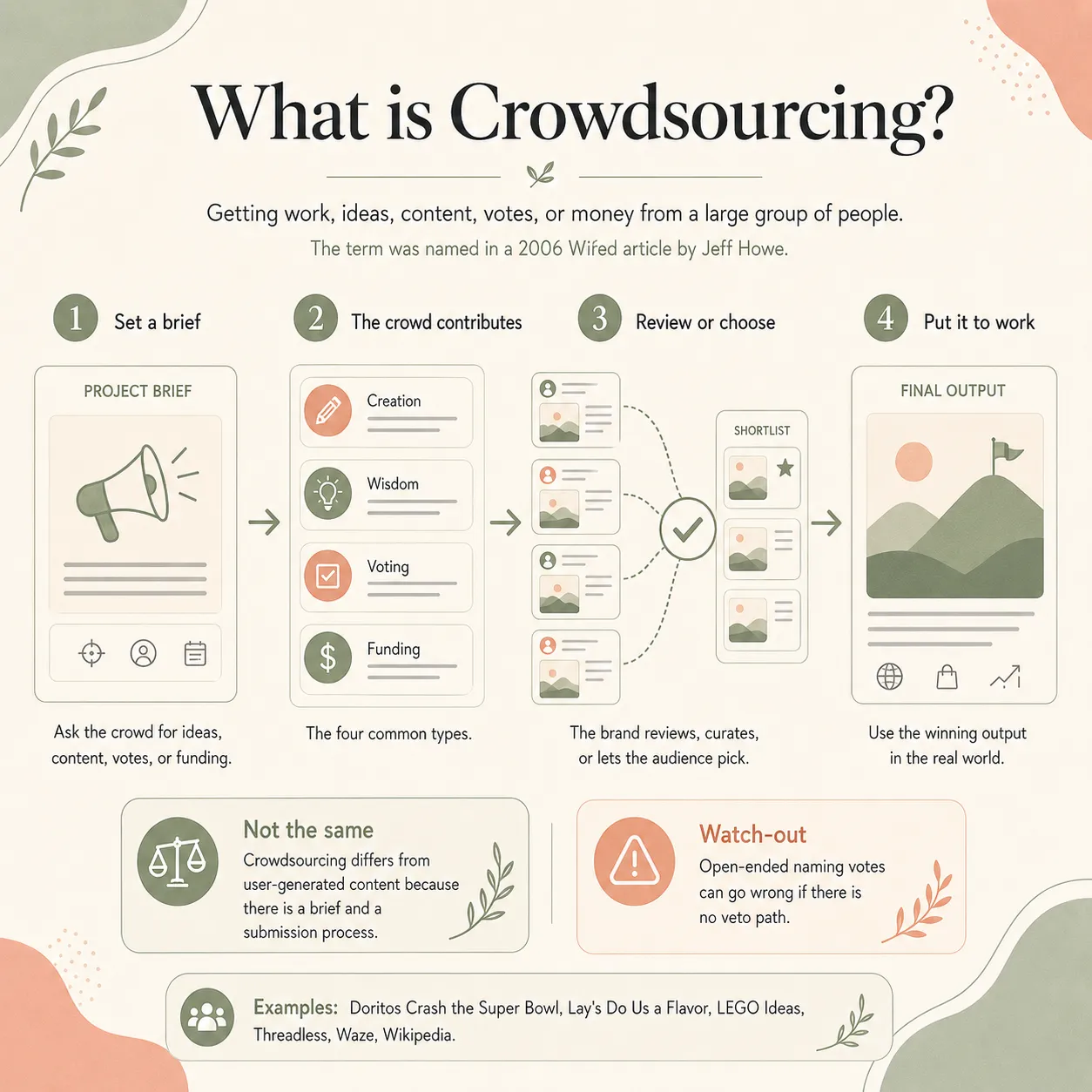
What is crowdsourcing?
Crowdsourcing is the move of taking a job that would normally sit with staff or a paid agency, and opening it up to a large group of people online instead. The job can be almost anything: write a slogan, design a T-shirt, name a product, suggest a flavour, build a Lego set, label an image, edit a Wikipedia entry, fund a new gadget on Kickstarter. The thread that runs through all of it is the same: a brief goes out, a crowd responds, and the organiser picks, aggregates, or funds the contributions that came back.
The word itself is fairly recent. The writer Jeff Howe coined it in a 2006 Wired article with his then-editor Mark Robinson, and the Wikipedia entry for crowdsourcing traces the path from there into product design, stock photography, software testing, scientific research, and the rest of the wider field. Merriam-Webster picked up the verb form not long after and defines crowdsource as the practice of obtaining needed services, ideas, or content by soliciting contributions from a large group of people, especially from the online community, rather than from traditional employees or suppliers.
For social media teams the working definition is narrower than the one in the dictionary. Most of the time, crowdsourcing on social means a campaign with a clear brief and a deadline: submit a photo of your dog with the product, vote on the next flavour, name the new colour, tell us your worst Monday in one sentence. The brand collects, picks, and rewards. The audience gets to be part of the thing rather than the target of it.
The main types of crowdsourcing
Most useful guides split crowdsourcing into four shapes, which cover the vast majority of what brands and platforms actually run. Sprout Social's glossary entry on crowdsourcing lands on a similar split, and the categories below match the ones marketers tend to recognise.
Crowd-creation (the contest model)
The crowd makes the content. Doritos asking the public to film a Super Bowl commercial, Threadless asking artists to submit T-shirt designs, LEGO asking fans to submit set ideas, a brand asking customers to send in photos of the product in use. The submissions are usually graded against a brief, the best ones get cash, royalties, or production, and the rest of the entries become a marketing asset in their own right because they show how many people cared enough to enter.
Crowd-wisdom (the open-question model)
The crowd answers a question the organiser cannot answer alone. Stack Overflow on a technical question, Quora on a knowledge one, the Reddit thread that gets a useful answer in twenty minutes, the research team using InnoCentive to put a hard problem in front of thousands of scientists. For brands, crowd-wisdom is the version that asks the audience to tell the team what they actually want, rather than asking them to vote on what the team has already drafted.
Crowd-voting (the pick-this-one model)
The crowd chooses between options the organiser has already prepared. Lay's Do Us a Flavor running the final round as a public vote, a clothing brand asking Instagram Stories which of three prints should go to production, a city asking residents to pick the design of the new park bench. The vote works as both a decision and a marketing event, because the people who voted have an opinion to defend once the result lands.
Crowdfunding (the money model)
The crowd puts in money rather than work. Kickstarter, Indiegogo, GoFundMe, equity crowdfunding on Republic or Seedrs, donation campaigns on JustGiving. Crowdfunding is the most quantitative kind of crowdsourcing, because the money flowing in is also the demand signal, and the campaigns that hit their target are the ones that have already proved the product would sell.
Microtasking (the piecework model)
The crowd does small repeatable tasks. Amazon Mechanical Turk paying a few cents to label an image, a data labelling platform paying a worker to draw a bounding box around a stop sign for self-driving training data, OpenStreetMap volunteers tagging a road segment, ReCAPTCHA quietly using the audience to digitise old books while they prove they are not a robot. Microtasking is the version that lives behind the scenes and powers most of the practical-AI plumbing of the modern internet.
Most brands only ever use the first three. The fourth and fifth (crowdfunding and microtasking) tend to belong to a product team or an operations team rather than a social one, and they show up in the conversation when a launch is on Kickstarter or a model is being trained, not when a campaign is being planned for next quarter.
Crowdsourcing vs UGC vs crowdfunding
These three get used interchangeably in meetings and they should not be. The short version of the split:
Crowdsourcing
There is a brief and an open call. The audience contributes inside a structure the brand set up, the brand picks or aggregates the results, and there is usually a clear endpoint. The pre-show flavour vote, the design contest, the Lego-set submission, the Kickstarter campaign. Whether the contribution is content, ideas, votes, or money is what splits the categories inside crowdsourcing.
User-generated content (UGC)
The audience posts on their own. There may or may not be a hashtag, there may or may not be a prompt, but there is no submission process, no shortlist, no winner. UGC happens whether or not the brand asked, and the brand's job is to find it, repost it with permission, and respect the original creator. A customer's unboxing Reel is UGC. The same brand running an unboxing-photo contest is crowdsourcing.
Crowdfunding
A specific kind of crowdsourcing where what the crowd contributes is money. Kickstarter pre-orders, Indiegogo perks, GoFundMe donations, equity crowdfunding for an investment stake in a company. Every crowdfunding campaign is also a crowdsourcing campaign; not every crowdsourcing campaign involves money.
The practical test in a planning meeting is the brief. If there is a clear brief and a way to submit, the project is crowdsourcing. If there is a hashtag and a hope that people will post, the project is a UGC campaign. If the entry mechanism is a payment page, the project is crowdfunding.
Famous crowdsourcing examples
A short tour of the campaigns most marketers cite when they explain what good crowdsourcing looks like. The pattern across all of them is a tight brief, a clear reward, and an editorial filter at the end so the worst submissions never make production.
Doritos Crash the Super Bowl
From 2006 to 2016, Doritos asked the public to film Super Bowl commercials for the brand. The 2014 winning entry, Time Machine, was a $300 production made in six hours by an aspiring filmmaker, and it ran during the most expensive thirty-second slot on US television. HubSpot's piece on the campaign in its guide to crowdsourcing in marketing covers the run end to end, and the model has been copied by almost every major consumer brand at least once since.
Lay's Do Us a Flavor
PepsiCo's Lay's brand has run the flavour-submission contest since 2012, with the audience submitting ideas and then voting on the finalists. The winners (Cheesy Garlic Bread, Wasabi Ginger, Southern Biscuits and Gravy, among others) have gone to production and back. The structural trick is that the public vote happens on a small shortlist the team has already screened, which keeps the result on-brand without losing the audience-decides energy.
LEGO Ideas
The cleanest long-running case study. The LEGO Ideas platform at ideas.lego.com asks fans to submit set designs, the community votes by hitting 10,000 supporters, and LEGO's internal team reviews everything that clears the bar. Sets that go to production pay the original designer a royalty on each unit sold. More than 60 fan-designed sets have gone to retail since the platform launched, including Saturn V, the Ghostbusters Ecto-1, and the original Doctor Who set.
Threadless
The whole company is built on crowdsourcing. Independent artists upload T-shirt designs, the community scores and votes on the submissions, the highest-rated designs go to print, and the artists earn cash and royalties. Threadless predates most of the wider conversation about creator economies and has been running the same loop since the early 2000s.
Waze and OpenStreetMap
Two crowdsourcing projects that quietly run a chunk of how people get around. Waze's traffic data is gathered from the driving sessions of its own users; OpenStreetMap's maps are built and edited by a community of volunteers. Neither runs a content contest. Both produce data products that compete with billion-dollar internal teams, and both are reminders that crowdsourcing is bigger than the marketing-stunt version of itself.
Wikipedia
The original modern crowdsourcing project at scale. Volunteers write, edit, and source the entries on terms in this glossary among everything else, and the result is the largest reference work in human history. The Wikipedia model is the proof point that crowdsourcing can produce work that holds up against professional editorial teams, given enough volunteers and a halfway-decent moderation layer on top.
The common factor in the campaigns that worked: the brand decided in advance what range of answers it would accept, and the audience chose inside that range. The factor in the campaigns that did not, covered in the next section, is usually the opposite.
When crowdsourcing works on social media
Crowdsourcing on social does its best work when the brand wants to do three things at once: produce something useful, find out what the audience actually thinks, and earn the engagement that comes from people having a stake in the result. The campaigns that hit all three share a few ingredients.
A narrow, specific brief
"Submit your worst Monday in one sentence" beats "tell us how you feel about Mondays" by a long way. A specific brief gives the audience something to react to in twenty seconds and gives the team a way to grade the entries against a shared bar. The wider the brief, the messier the submissions and the harder the editorial cut at the end.
A reason to submit beyond the prize
Prize-driven crowdsourcing works at scale (Doritos Crash the Super Bowl, Lay's Do Us a Flavor), but the smaller version of the same idea relies on the audience getting something else: recognition on the brand's feed, a feature in a future post, the satisfaction of seeing their own contribution become part of the thing. The campaigns that flop with no prize and no other reward to give are the ones that read like the brand wanted free labour.
A submission path the audience already lives in
Asking people to fill in a Google Form takes more friction than the post that asked them is worth. Asking them to reply to a Threads post, tag a friend in an Instagram caption, or upload a clip to TikTok with a sound takes none. The closer the submission mechanism is to the platform's native behaviour, the more entries land.
An editorial filter before anything goes public
Every crowdsourcing disaster you have ever read about can be traced back to a brand letting the result of the vote go straight to production without a human in the loop. The campaigns that worked all kept the right to filter, shortlist, and veto, and the audience usually accepted the filter as long as the team was clear about it up front.
Credit and reward that match the contribution
Tagging the customer whose photo got featured, paying the artist whose design went to print, sending the LEGO designer their royalty cheque. Crowdsourcing campaigns that quietly absorb the work without crediting the people who did it tend to be the last one the brand ever runs successfully.
The wider lesson from twenty years of running these campaigns: the audience is happy to do the work, as long as the work feels like a contribution rather than a draft of an unpaid agency gig. Most of the brands that get crowdsourcing right end up running the same campaign annually because the audience explicitly asks for it back.
When crowdsourcing backfires
Two campaigns get cited every time the subject comes up, because both turned into textbook examples of the same mistake: putting an open-ended naming vote in front of the public with no veto path and no editorial filter, and being surprised when the internet did what the internet does.
Mountain Dew's 2012 Dub the Dew campaign asked the public to name a new green-apple flavour and put the submissions on a leaderboard before anyone graded them. The leader at the time the page was pulled was a name that cannot be repeated on the brand's own glossary site, and the campaign was killed inside a few days. The brand caught the problem before anything went to market, but the case study now sits in every "do not crowdsource a name" deck on the internet.
The 2016 NERC poll covered in the Boaty McBoatface Wikipedia article is the friendlier version of the same mistake. The UK's Natural Environment Research Council asked the public to suggest names for a £200 million polar research ship, the entry Boaty McBoatface won with 124,109 votes, and the council eventually overrode the vote and named the ship the RRS Sir David Attenborough, with the name Boaty McBoatface going to the autonomous submersible instead. The British Antarctic Survey's announcement is the official record of the decision. Nobody got hurt, the ship sails, and the case became a permanent lesson on what happens when a brand puts a creative vote on the internet without a way to step in.
The pattern is consistent. Crowdsourcing fails when the brand surrendered the editorial seat before the campaign started, gave the audience an open-ended creative job with no shortlist, and trusted the result to be on-brand because the people voting were a self-selected mix of customers, critics, and the wider internet. The audience is rarely the problem; the brief almost always is.
How to run a crowdsourcing campaign on social
A practical workflow that fits inside one quarter for a small team, and scales up to a major campaign without changing shape.
- Decide what the crowd actually owns. Content, idea, vote, or money. The four shapes have different mechanics and the rest of the plan changes once this is settled. Most teams that start with "let's do something crowdsourced" without picking one end up running a UGC campaign with extra steps.
- Write the brief in one sentence. If the brief cannot fit in a caption, the audience will not read it. "Submit your worst Monday in one sentence and we will pick five to feature next week" is a brief. "Share your stories about how our brand helps you live your best life" is not.
- Pick the submission mechanism the audience already uses. Replies, tagged posts with a hashtag, a duet or stitch on TikTok, an Instagram Stories sticker, a DM to the brand account. Anything off-platform halves the entry rate at best.
- Set the editorial filter in writing. A shortlist, a final pick, a moderation policy, and the right to remove entries that break the rules. State the filter in the rules at the start. The audience will accept a filter they were warned about; the same audience will burn the brand down if the filter shows up after the vote.
- Decide the reward before the campaign goes live. Cash, royalties, a feature post, a free product, public credit, a place in the next campaign. The reward sets the tone of the whole brief and tells the audience what kind of campaign this actually is.
- Plan the publish calendar around the submissions. The campaign is not the call for entries; it is the trail of content the entries make possible. The shortlist post, the finalist explainers, the announcement, the winner interview. Roughly three to six posts of follow-on content come out of one well-run campaign.
- Credit everyone who contributed in public. Tag every featured entrant, name the winner, link the designer's account. The campaign that follows next year will run twice as well because the audience saw the last one treat its contributors right.
Common crowdsourcing mistakes
The mistakes below show up in almost every crowdsourcing post-mortem. Most of them can be fixed by adding one paragraph to the brief.
- Asking the public to name a product with no shortlist. Dub the Dew, Boaty McBoatface, every copycat poll that came after. Naming votes only work when the audience picks from a shortlist the team has already screened.
- No moderation budget. A submission page without a person clearing entries turns into a leaderboard of the rudest possible answers inside a weekend. Build moderation into the campaign as a line item from day one.
- Counting on free labour from an audience the brand has not earned yet. Crowdsourcing campaigns work best from brands the audience already likes. A small brand asking strangers for free creative work tends to get tumbleweed; the same brand asking its existing customers for a quick contribution tends to get a flood.
- Skipping the rights and licensing terms. Submissions that end up in production need clear rights assignment, and contributors need to know up front that their entry could become a product, a campaign asset, or a paid ad. Leaving the licence ambiguous is how crowdsourcing campaigns end up in court a year later.
- Treating the campaign as the goal instead of the start. A good crowdsourcing run produces an audience asset, a product asset, and a content asset. The brands that stop at the campaign itself miss most of the value. The brands that build the next quarter's content pillars on top of the submissions get a return measured in months rather than days.
- Forgetting to credit contributors in public. The fastest way to make sure the next campaign flops. A public tag, a named credit, a link back to the contributor's account. Costs nothing, pays back the rest of the year.
- Ignoring the long tail of submissions that did not win. Most crowdsourcing campaigns get 90% of their value from the long tail rather than the winner: the patterns in what people submitted, the themes that came up repeatedly, the unprompted comments under the campaign posts. Reading the long tail is the cheapest qualitative research the brand will run all year.
For the wider planning context this sits inside, the campaign entry covers how a crowdsourcing run fits next to the rest of the quarter, and the brand awareness entry covers the longer-term effect campaigns like Lay's Do Us a Flavor have on how easily the brand is recognised in the first place.
Crowdsourcing FAQ
Who coined the term crowdsourcing?
The writer Jeff Howe coined the word in a 2006 Wired article, working with the magazine's then-editor Mark Robinson. The piece described a pattern Howe was watching across stock photography, T-shirt design, and product research, where companies were asking the public to do work that used to belong to staff or agencies. The word stuck because nothing else fit the shape of what was happening, and Merriam-Webster picked up the verb form a few years later.
What is the difference between crowdsourcing and crowdfunding?
Crowdfunding is one specific kind of crowdsourcing, the kind where what the crowd contributes is money. Kickstarter, Indiegogo, GoFundMe, and the equity crowdfunding platforms all sit inside the wider crowdsourcing bucket, but the wider bucket also covers ideas, votes, designs, tasks, and information. A campaign that asks the audience to submit chip flavours is crowdsourcing. A campaign that asks the audience to pre-order the product on Kickstarter is crowdfunding, which is a subset of crowdsourcing.
Is crowdsourcing the same as user-generated content?
They overlap and they are not the same. User-generated content is anything an audience posts about a brand on their own, with or without a prompt: reviews, unboxing videos, the Reel a customer made after a haircut. Crowdsourcing is the version where the brand asked, set a prompt, ran a structured submission process, and usually picked a winner. The simplest test is whether there was a brief. UGC happens whether or not the brand wanted it; crowdsourcing only happens because the brand asked for it.
Do you have to pay people for crowdsourced contributions?
Not always, and the rules vary by what is being crowdsourced. Wikipedia, OpenStreetMap, and most open-source crowdsourcing run on volunteer contributions. Contests with a prize (Doritos Crash the Super Bowl, Lay's Do Us a Flavor, LEGO Ideas) pay cash, royalties, or a per-set percentage to the winners. Microtask platforms like Amazon Mechanical Turk pay piecework rates. The thing that gets brands into trouble is asking the public for free labour they would normally pay an agency for, and then keeping the work without acknowledging the contributors. A small prize and a clear public credit is the practical floor for most consumer crowdsourcing.
What is the best crowdsourcing platform?
There is no single platform because the category covers very different jobs. For raising money, Kickstarter and Indiegogo lead the consumer side and Republic or Wefunder handle equity. For product ideas, LEGO Ideas, IdeaScale, and InnoCentive run the structured-contest model. For microtasks, Amazon Mechanical Turk and Appen are the long-standing options. For social-media-led crowdsourcing of submissions, photos, votes, or stories, most brands run the campaign on Instagram, TikTok, or LinkedIn directly, with a scheduling tool collecting the submissions and a simple landing page handling the entry rules.