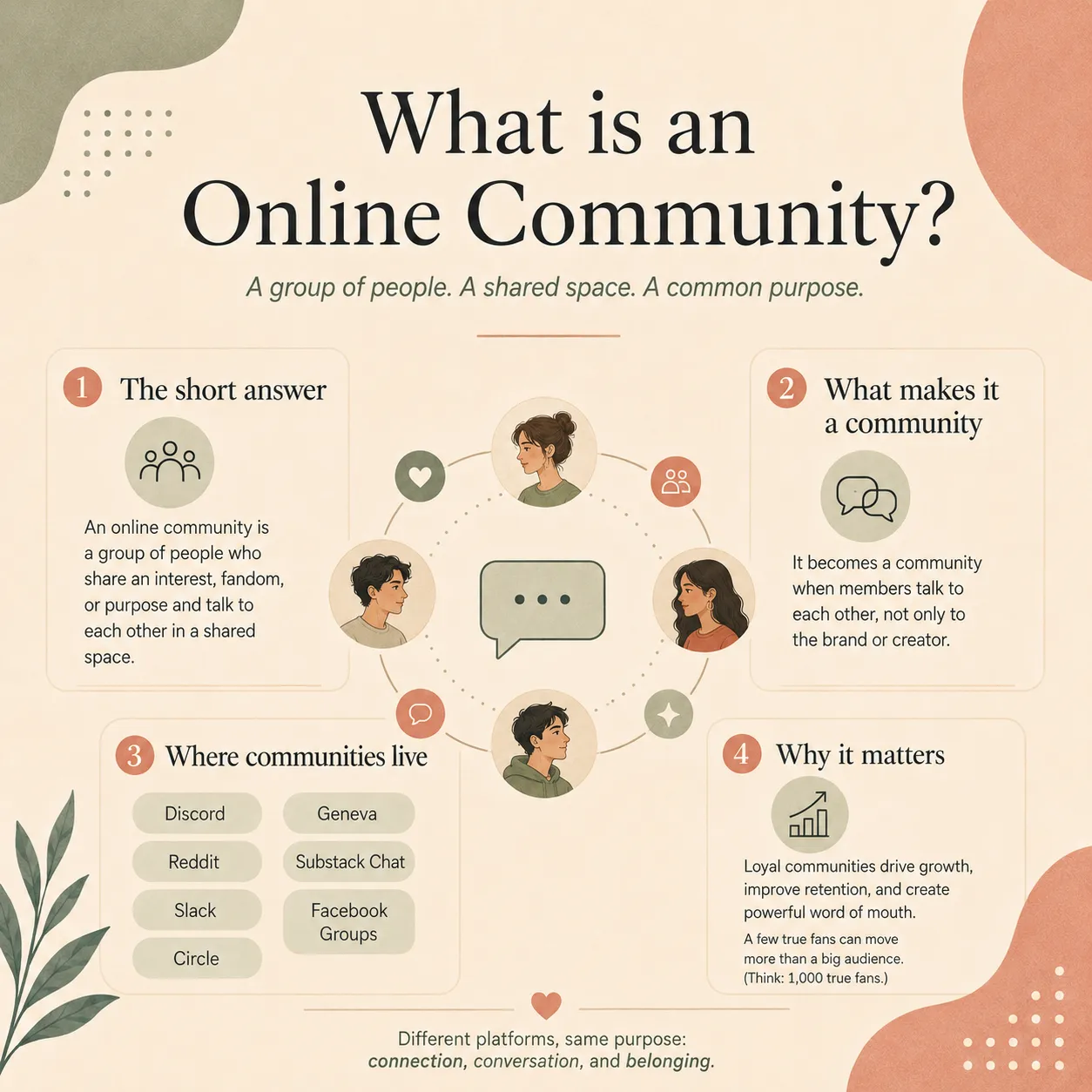
A community is a group of people who share an interest, a fandom, or a purpose and who talk to each other (not just to the brand or the creator) inside a shared channel, which on social media in 2026 is most often a Discord server, a Geneva group, a Slack workspace, a Circle space, a Substack chat, a subreddit, or a Facebook group sitting next to the public social accounts a brand or creator already runs.
What is a community in social media?
A community, as the word is used inside social media strategy in 2026, is a group of people who share an interest, a fandom, or a purpose and who talk to each other through some shared channel. The channel can be a Discord server, a Slack workspace, a Geneva group, a Circle space, a Substack chat, a subreddit, a Facebook group, a private Telegram channel, or even the recurring comment section underneath a creator's posts on a single platform. The working test is whether anything happens inside the space when the brand or the creator is not actively posting; if members talk to each other, it is a community, if they only talk to the brand, it is an audience.
Sprout Social's working definition, in its brand community guide, is “a place where people who have an emotional connection to your brand can connect with each other and with your brand,” which is the phrasing most strategy decks use in 2026. The two halves of that sentence matter equally: connection with each other is what makes the space a community, and connection with the brand is what makes it a brand community rather than a generic interest group.
The word community itself is older than the internet by several thousand years, but the social-media usage has narrowed it to mean a small, active, often opt-in subgroup of the wider audience: the 2,000 Discord members rather than the 200,000 Instagram followers, the 800 Substack chat subscribers rather than the 30,000 newsletter readers, the 300 paying Circle members rather than the wider YouTube subscriber base. The community is the dense core of the audience; the audience is everyone the brand has reach to.
Community vs audience vs followers
Three closely related words that mean different things. Most of the strategy mistakes brands make with community come from collapsing the three together. The clearest version of the distinction is below.
Followers
The largest, loosest layer. A follower is anyone who has tapped the follow button on Instagram, TikTok, LinkedIn, X, or YouTube. The platform owns the relationship, the algorithm decides how much of the brand the follower ever sees, and the share of followers actually reached on a typical post is now 2 to 4 per cent on Instagram and 1 to 2 per cent on Facebook. A follower is a number; it is not a relationship the brand controls.
Audience
The middle layer. An audience is the set of people who actively pay attention to the brand: the regular openers of the newsletter, the regular watchers of the YouTube channel, the regular readers of the blog. The brand has a direct line to most of them (email, RSS, a podcast subscription), and the engagement is one-to-many: the brand publishes, the audience consumes. There is no member-to-member conversation by default.
Community
The densest, smallest layer. A community is the subset of the audience that talks to each other as well as to the brand. The members know each other's handles, recognise the regulars, and continue the conversation when the brand is not in the room. The community is almost always smaller than the audience and the audience is almost always smaller than the follower count, with each layer adding more engagement and more loyalty in exchange for less reach.
Why the distinction matters
Each layer is good at different jobs. Followers are good for top-of-funnel discovery and for proof of social scale. The audience is good for trust, for owned-channel reach, and for steady revenue. The community is good for retention, for product feedback, for word-of-mouth referrals, and for the kind of loyalty that survives a bad month for the brand. A working business strategy on social in 2026 is usually building all three at once.
Why brands invest in community in 2026
The reason almost every brand book published since 2022 has a community chapter in it is that the surface conditions on social have changed. Organic reach on Facebook page posts is at 1 to 2 per cent; paid acquisition costs have roughly doubled across most categories since 2019; the iOS 14.5 attribution changes in 2021 made paid measurement meaningfully worse; and the cost of a churned customer has gone up across every subscription business. Community is the channel that fixes some of all of that.
Insulation from algorithm change
A Discord server, a Slack workspace, or an email list cannot have its reach turned off by a platform algorithm shift. The brand owns the channel, the channel reaches every member who logs in or opens the message, and the platform sitting in the middle (Discord, Slack, ConvertKit) is paid by the brand rather than the other way around. The retention layer survives whatever the next Facebook reach cut looks like.
Cheaper acquisition through referrals
Community members refer the brand to friends at multiples of the rate non-community customers do. The structure of a community (the in-jokes, the shared identity, the recognisable regulars) is the structure that produces word-of-mouth, and word-of-mouth is the cheapest acquisition channel any business has. CMX's industry surveys put the share of community professionals who say community has had a positive impact on the business at 80 to 85 per cent over the last several reports.
Better retention and lower churn
A customer who is in the brand's community is meaningfully less likely to cancel the subscription, switch to a competitor, or churn at renewal. The community is the social cost of leaving: the customer who has built relationships inside the space stays for the people more than for the product.
Faster product feedback
A community is the cheapest user research panel a brand can run. A question posted in a 500-member Discord usually gets fifty responses by the next morning, the responses come from actual customers rather than a survey panel, and the depth of the answers is higher because the respondents already trust the brand enough to share.
Long-term defensibility
A competitor can clone the product; the community is harder to clone. A 5,000-member Discord with three years of shared in-jokes and a recognisable culture cannot be replicated by a better-funded startup launching next quarter. Community is the moat most product brands eventually realise they should have started building three years earlier.
CMX's longer write-up on community-led programs frames the point the same way: brands that build a working community are taking the corporation out of the conversation and giving the torch to the customers, and the customers do a better marketing job than the marketing team was doing on its own.
The platforms where communities actually live
There is no single best community platform; the right one depends on who the audience is, what the community is for, and whether it is free or paid. The working state of each platform in 2026 is below.
Discord
The largest free community platform on the open internet, born in gaming and now hosting communities across personal finance, AI tools, entrepreneurship, fitness, fandom, and almost every creator category. Free, voice and text channels, deep customisation, and a younger audience skew. The trade is that Discord requires moderation work to keep a server welcoming, and the chronological-feed shape makes it hard for newcomers to catch up on what they missed.
Geneva
The group-chat-shaped community platform that has grown fastest among Gen Z and the more intimate, smaller-community use case. Free, polished, simpler than Discord, and the favoured platform for fashion, beauty, wellness, and creator-led microcommunities. Geneva is the right call when the community is fewer than a thousand people and the vibe is closer to a private group chat than a town square.
Slack
The B2B and professional community platform. Slack workspaces are the home of marketing communities, founder groups, SaaS user communities, and almost every paid community aimed at professionals. The trade is that Slack is built for work, which means notifications are loud and the engagement rate drops fast unless the moderation team keeps the noise down.
Circle
The paid creator-and-membership platform. Circle gives creators and small businesses a community space with payment processing, course delivery, events, and analytics built in. The right pick when the community is the product (a paid membership, a course cohort, a mastermind) rather than a free layer on top of an existing product.
Skool
The other paid creator-community platform, with a heavier emphasis on courses and gamified engagement (points, levels, leaderboards). Has grown fast among creators in personal development, marketing, and online business categories where the audience responds to a clear progression system.
Substack chat and Substack Notes
Lightweight community layers built into the Substack platform. Substack chat is private to a newsletter's subscribers and works well for writers building intimacy with a paid audience; Notes is more public and works as a Twitter-style discovery layer alongside the newsletter. Neither is a full community platform, but both are usable layers for newsletter-led brands.
The largest topic-led community network on the web, with a different shape to the platforms above: members are usually anonymous, the conversation is threaded and ranked rather than chronological, and the community lives inside a subreddit rather than around a single brand. Reddit communities are the right call for topic-led audiences (hobbyists, fans, niche professional groups) where the brand is one voice among many rather than the centre.
Facebook groups
The older community platform that still works for older audiences (40 plus) and for local groups. The interface is dated, the discovery is uneven, but the network effect of Facebook itself means a group can grow to tens of thousands of members faster than on most newer platforms.
How to build a brand community
Brand communities do not appear because the brand opened a Discord and posted “welcome”. They are built deliberately, over months, around a few specific decisions the founder or the community manager makes early. The list below is the working pattern most successful brand communities have followed.
- Pick the audience the community is for. Communities work when the membership is specific. “Our customers” is too broad; “UK ecommerce founders doing under £5m revenue” is specific enough that the people inside the community recognise each other.
- Pick the platform the audience already uses. Do not ask the audience to learn a new app for the community. Find out where they already spend time (Discord for gaming and youth; Slack for B2B; Geneva for Gen Z; Facebook groups for older or local audiences) and run the community there.
- Define the purpose in one sentence. “A place for X to share Y with Z”. The sentence sits at the top of the welcome channel forever and tells every new member what the community is and is not for. Communities that drift do so because the purpose was never written down.
- Seed the first 50 members manually. Personally invite the first 50 people. Not 500, not 5,000; 50. The first 50 set the culture, the norms, and the tone of voice that everyone after them inherits. Skip this step and the community ends up generic.
- Set the moderation policy before you need it. Write down what the community is for, what behaviour is welcome, and what behaviour will get someone removed. Put it in a pinned message. Apply it from day one. Communities that go bad almost always did so because the moderation policy was written reactively after a problem rather than proactively before one.
- Show up consistently for the first 90 days. A community is built on the founder or the community manager being there every day for the first three months. After that the members carry the conversation themselves; before that they need to see someone setting the example. The single biggest reason new communities die is that the founder posted three times in week one and disappeared.
- Run rituals that repeat weekly. Weekly check-in threads, monthly office hours, a regular show-and-tell, a recurring AMA. Rituals are the scaffolding of community life and are what gives the regulars something to come back for. Communities without rituals are just chat windows.
- Notice the superfans and give them a role. Every community has a small share of members who contribute most of the conversation, run the side channels, welcome the newcomers, and answer the questions. Identify them, name them as moderators or ambassadors, and give them the recognition and the access that turns active members into long-term community leaders.
Community-led growth, the formal concept
Community-led growth is the formal name for the strategy of treating the community itself as the primary engine of customer acquisition, retention, and product development. The term came out of the SaaS world in the early 2020s, with CMX (the Community Management Exchange, founded in 2014) as the central research and community-of-practice body, and the SPACES Framework as the most-cited model for what a community-led strategy can do for a business.
Support
The community as the first line of customer support. Members answer each other's questions before the support team has to. Companies running this well (Notion, Figma, Webflow) measure the share of inbound support tickets that are resolved peer-to-peer inside the community rather than by the company itself.
Product
The community as the product feedback loop. Members suggest features, vote on roadmap priorities, beta test new releases, and find bugs that QA misses. The shorter the loop between the product team and the community, the faster the product gets to what the customer actually wants.
Acquisition
The community as the top-of-funnel referral engine. Members refer the product to friends and colleagues, write public posts and reviews, and create user-generated content that does the marketing work the brand would otherwise have to pay for.
Contribution
The community as a contributor base. Members write content, host events, build integrations, run sub-groups, and produce the bulk of what makes the brand visible across the wider internet. Open-source projects are the clearest version of this; most modern community-led brands borrow the shape.
Engagement
The community as the audience for the brand's own content. Members are the highest-engagement audience the brand has, the first comments on the new YouTube video, the first replies to the LinkedIn post, the people sharing the launch announcement before the launch announcement is even live.
Success
The community as the customer-success layer. Members onboard each other, share workflows and templates, and help newer customers get to the value of the product faster than the customer-success team alone could. This is most of why community-led SaaS companies see lower churn than their non-community peers.
How to measure a community
Measurement is where most brand communities go wrong, because the obvious metric (total members) is the wrong one and the right metrics (engagement density, retention, member-to-member contribution share) are harder to read. The working dashboard below is the one most experienced community managers settle on.
Weekly active members
The single most important number. The share of the membership that posted, commented, reacted, or otherwise contributed something inside the last seven days. A healthy community runs at 20 to 40 per cent weekly active; a community below 10 per cent is sliding toward dead, and a community at 50 per cent or higher is either small or genuinely exceptional.
Member-to-member message ratio
The share of messages inside the community that come from members rather than from the brand or the moderation team. A healthy community has members producing 70 to 90 per cent of the messages; if the brand is producing more than half, it is still an audience rather than a community.
New threads started per week
How many independent conversations the members are starting, not counting replies. A community that produces 20 to 50 new threads a week is healthy; one that produces fewer than five is on its way out and needs intervention.
Retention curve
The share of members still active 30, 90, and 180 days after they joined. A community with 60 per cent of joiners still active at day 30 is doing well; one with 10 per cent of joiners still active by day 90 is leaking faster than it is filling.
Member NPS or community survey scores
A simple yearly or quarterly survey asking members how likely they are to recommend the community, what they like, what they would change. Self-reported but useful because it catches the cultural-health signals the analytics dashboard cannot.
Business outcomes
For brand communities the dashboard should also show the share of customers who are members, the retention or churn delta between community members and non-members, and the share of new acquisitions that came through a community referral. These are the numbers that tell the rest of the company whether the community is paying for itself.
Common community mistakes
- Confusing audience size with community. A 100,000-follower Instagram account is not a community; it is an audience. The number on the profile page tells you nothing about whether anyone is talking to anyone else. Most brands looking at their follower count and saying “we have a community” have not yet built one.
- Building the community before the audience is ready. A brand with 200 newsletter subscribers and no traction opening a Discord is opening a quiet room. Communities work when there is already enough audience density to seed 50 active early members; before that, the community is the wrong investment and the energy is better spent building the audience first.
- Picking the wrong platform. A 55-plus customer base will not learn Discord; a Gen Z fashion community will not log into a Slack workspace. Picking the platform the founder is comfortable with rather than the platform the audience already lives on is one of the most common reasons a community fails to gain traction.
- Treating the community as a broadcast channel. A Discord where the brand posts announcements and the members never reply is not a community, it is a newsletter with extra friction. The job of the community is to host member-to-member conversation; if the brand is the only voice talking, the community has not formed yet.
- Skipping the moderation work. Communities that go bad almost always do so because no one was watching for the early signs (a few aggressive members, off-topic drift, spam). Moderation is unglamorous work that compounds over time; the communities that thrive are the ones whose founders treated moderation as a first-class job rather than something to figure out later.
- Burning out the founder. New communities depend on the founder showing up every day for the first 90 days. The founders who turn this into a sustainable habit hand off rituals to community ambassadors and trusted moderators; the founders who do not get tired and disappear, and the community dies.
- Measuring the wrong numbers. Total members on the dashboard makes the chart go up; weekly active members tells the truth. A community report that leads with member count and not engagement density is hiding the answer the brand needs to see.
- Forgetting the public side of the brand. A community is the dense core of an audience the brand still needs to feed. A brand that pours all its energy into the private community and stops publishing the public posts that bring in new members is starving the top of the funnel and the community will shrink with it.
For the surrounding context this entry sits inside, the community manager entry covers the role that does most of the day-to-day work of running the community, the creator economy entry covers the working environment in which most modern community businesses live, the brand awareness entry covers the wider-audience job sitting outside the dense community core, and the follower growth entry covers the public-account work that feeds the community from the top of the funnel.
Kevin Kelly's 2008 essay on 1,000 True Fans and Sprout Social's community management guide sit alongside the CMX work as the three references most community professionals quote when they are explaining the shape of the job to someone new to it. The matching tools on this site cover the wider-audience side of the same work: the social media strategy template maps the public posts that feed the community, engagement rate calculator benchmarks the public side against the working platform medians, and the UTM builder tags the outbound links from public posts back to the community sign-up page.
Community FAQ
What is an online community?
An online community is a group of people who share an interest, a fandom, or a purpose, and who talk to each other (not just to the brand or the creator) through some shared channel. The channel can be a Discord server, a Slack workspace, a Geneva or Circle group, a Substack chat, a Reddit subreddit, a Facebook group, or the comments under a creator's posts. What turns a follower list into a community is the member-to-member talking; the difference between an audience and a community is whether the people inside it know each other or just know you.
What is the difference between a community and an audience?
An audience is a group of people pointed at the brand or the creator; a community is a group of people pointed at each other. A 500,000-follower account with no comments and no member-to-member conversation is an audience; a 2,000-member Discord where people are answering each other's questions every day is a community. The two can overlap and a brand can have both, but the working test is whether anything happens inside the space if the brand stops posting; if it does, it is a community, if it does not, it is an audience.
Why do brands build communities?
Three reasons that show up in almost every brand community case study. Audience loyalty, because community members buy more often, churn less, and recommend the brand to more people than non-community customers do. Insulation from algorithm change, because a community lives on the brand's own server or list, not on a platform that can choke off organic reach at any time. And the cheapest acquisition channel any brand has, because the customer who already bought once is the easiest person to ask for a referral, and the community is the structure that makes those referrals natural rather than forced. CMX's research on community-led programs lines up with all three.
What is the best platform for a brand community?
It depends on who the audience is and what the community is for. Discord works for gaming, creator, and youth-leaning communities and is free; Geneva works for Gen Z and the more intimate, group-chat shape of community; Slack works for professional and B2B communities; Circle and Skool work for paid memberships, courses, and creator businesses that want monetisation and analytics built in; Facebook groups still work for older audiences and local groups; subreddits work for the more anonymous, topic-led communities. The honest answer is to pick the platform the audience is already on, not the one the founder wishes they were on.
How big does a community need to be?
Smaller than most people assume. Kevin Kelly's 2008 essay "1,000 True Fans" set the working benchmark for creators: roughly a thousand people who each spend a hundred dollars a year on your work is a six-figure business. The same maths holds for brand communities; a 500-member Discord where 50 people are active every day is a more valuable asset than a 50,000-member Facebook group where 200 people are active every day. Density of conversation beats raw member count for almost every job a community is doing.
How do you measure a community?
By the engagement of the active members, not the size of the membership list. The numbers that matter are weekly active members (the share of the list that posted, commented, or reacted in the last seven days), daily active members for the most engaged communities, the ratio of member-to-member messages to brand-to-member messages, the number of new threads started by members per week, and the retention curve of members three, six, and twelve months after they joined. The vanity metric to avoid is the total member count; a Discord with 100,000 members and 50 active per day is mostly noise.