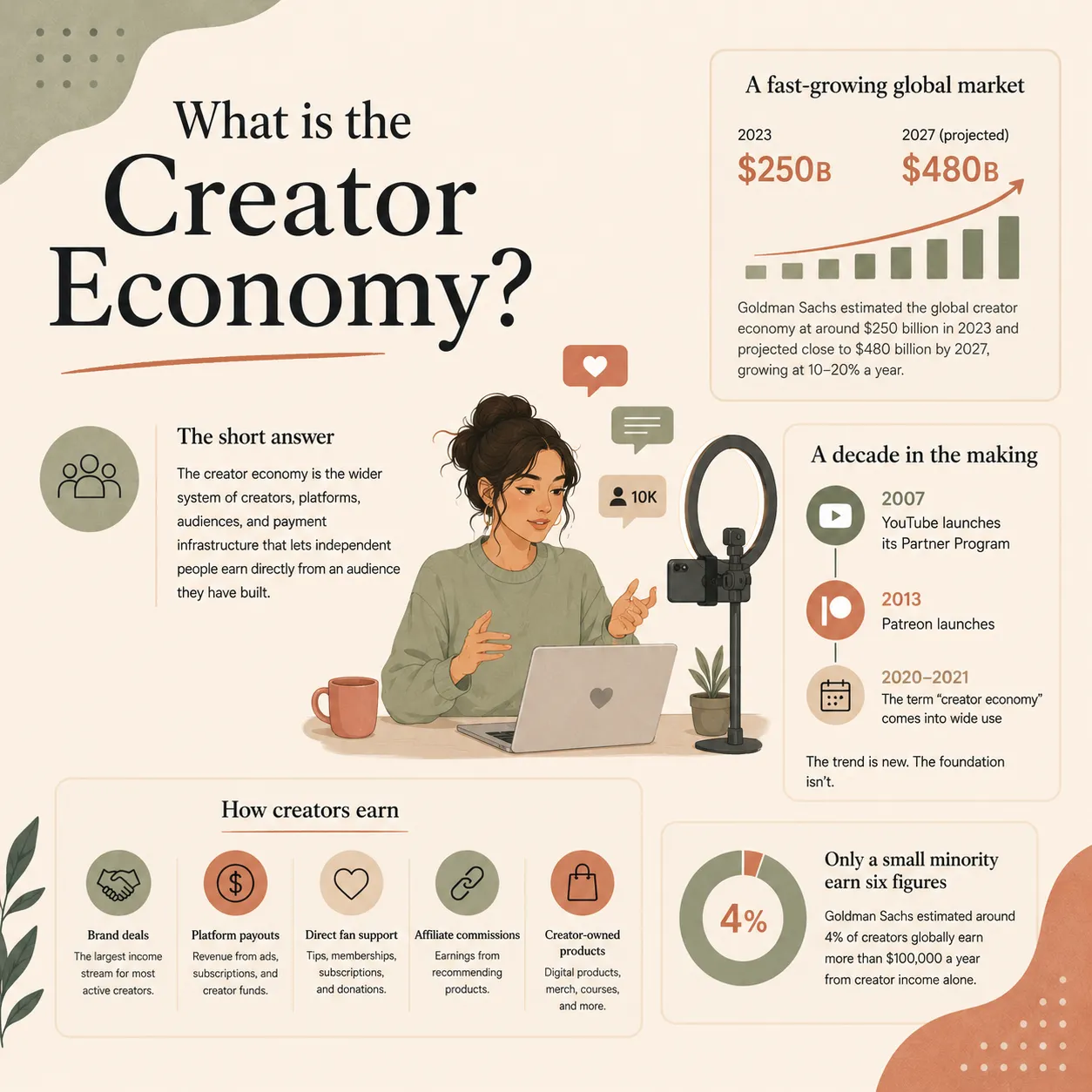
The creator economy is the wider system of creators, platforms, audiences, and payment infrastructure that lets independent people build a business out of an audience they own, rather than going through a publisher, label, studio, or employer to reach the same audience.
What is the creator economy?
The creator economy is what you call the whole system of people making things on the internet for an audience they reached themselves. The creators are the visible part, the platforms are the rails, the audience is the demand, and the payment infrastructure (ad revenue shares, subscriptions, brand-deal marketplaces, affiliate networks, e-commerce tools) is what turns the audience into income. Strip any of those four out and the system stops working; put them together and you get a market that, depending on whose number you trust, is now worth somewhere between a quarter and a third of a trillion dollars worldwide.
Wikipedia's definition is the simplest: "a platform-driven economy in which creators produce content, products, or services and distribute them directly to their audience through social media platforms and emerging technologies". Buffer's glossary entry on the creator economy adds the part that matters in practice, that creators monetise directly with their audience without a traditional middle layer of publisher, label, or studio. That direct-to-audience piece is the bit that makes the system different from the media economy it is slowly replacing.
The other useful framing is that the creator economy is what happens when distribution stops being scarce. For most of the twentieth century the bottleneck on reaching an audience was access to the channel: TV networks, radio stations, magazine racks, bookstore shelves. Once the platforms made distribution free at the point of upload, the bottleneck moved to attention, and the economy that grew up around that shift is what gets called the creator economy now.
How big is the creator economy?
The most cited number is Goldman Sachs' forecast that the creator economy could approach half a trillion dollars by 2027, growing from around $250 billion in 2023 to roughly $480 billion by 2027 at a 10 to 20 percent annual rate. Other analysts run from the mid $200s of billions to over $400 billion for the current year depending on what they count; every figure of that size depends on whether the analyst includes only direct creator earnings or layers in the platform ad revenue, the agency fees, the tooling industry, and the creator-owned brands sitting on top.
The shape of where the money sits is more useful than the headline. Brand deals are the largest revenue line for most professional creators (Goldman Sachs put it at around 70% of creator income), platform payouts and ad revenue shares come second, direct fan support and creator commerce trail behind. On the audience side, Sprout Social estimates roughly 50 million people worldwide identify as creators in some serious sense, though the line between "identifies as a creator" and "earns from creating" is wide enough to drive a truck through.
The earnings curve inside that 50 million is steep. Goldman Sachs estimated that only about 4% of global creators are professionals earning more than $100,000 a year, and other surveys land in the same range for the share earning enough to live on. The middle of the curve is partial income, the bottom is hobby. The reason the headline number looks so large despite the long tail is that the small top tier and the platforms themselves account for most of the dollars.
A short history of the creator economy
The phrase "creator economy" came into common use around 2020 and 2021, but the underlying activity is much older. The short version of the timeline is below, with the five moments most people pick out as load-bearing.
2007: YouTube Partner Program
YouTube launched its Partner Program in 2007, letting creators share in advertising revenue from their videos. This is the moment a creator could plausibly earn a living from a platform without a brand deal in sight, and most of the modern creator-economy infrastructure traces back to it.
2011: YouTube coins the word "creator"
Wikipedia's entry on the creator economy notes that YouTube introduced the word "creator" in 2011 as a friendlier replacement for "YouTube star". The label spread from there to the rest of the industry over the next decade and is now the default term for anyone making content on platforms.
2013: Patreon launches
Patreon launched in 2013 and turned recurring fan support into a serious income stream for creators whose audiences were too small for ad revenue to matter. Subscription-based creator income is the second major revenue lane the modern creator economy runs on, and most subsequent fan-funding products borrow from the Patreon shape.
2020: TikTok Creator Fund
TikTok introduced the Creator Fund in 2020, the first time a short-form video platform paid creators directly at scale outside of an ad-revenue split. Other platforms followed within a year (Reels Bonuses, YouTube Shorts Fund, Snap Spotlight), and the era of platform-funded creator payouts began in earnest.
2021: investors give the system a name
Through 2021 the venture capital industry put a name on what was already there. Signal Fire, a16z, and Lightspeed all published creator economy maps, the financial press picked the term up, and from that point onwards the field had a label most observers used the same way. The activity was older than the phrase by at least a decade.
What changed across that fifteen-year arc is not the basic idea (people make things on the internet, audiences pay attention, money flows around the attention) but the infrastructure that supports it. Each step removed a small piece of friction: monetisation without a manager, payments without a publisher, audiences without a network, products without a wholesaler, contracts without an agent.
Who counts as a creator?
The honest answer is that the line is blurry on purpose. Most analysts include the groups below; whether to count someone is usually a judgement call about whether they are earning directly from an audience they reached themselves rather than through an employer or commission.
Video creators
YouTubers, TikTok creators, Twitch streamers, the people running channels and accounts where the video itself is the product. The largest and most visible cohort, and the one most surveys mean when they say "creator".
Writers and newsletter authors
Substack writers, independent newsletter authors, blog-based creators, and the part of the field that overlaps with serious journalism. The audience size tends to be smaller than for video, the income per reader much higher because of paid subscriptions.
Podcasters
Independent podcasters with sponsorship deals, listener support on Patreon, or premium-feed subscriptions. The revenue mix on a serious podcast is closer to traditional media (sponsorship-heavy) than the rest of the creator economy.
Educators and course creators
Coaches, course sellers, workshop runners, and the half of the field whose product is a structured learning experience rather than a piece of media. The income per customer is high, the audience needed to make a living is much smaller, and the work overlaps heavily with consulting.
Artists, musicians, and craftspeople
Independent musicians on Bandcamp and Spotify, illustrators on Patreon, ceramicists running an Instagram-driven Shopify store. The creator-economy framing applies whenever the artist is reaching the audience directly, even when the underlying work is craft rather than content.
Influencers and personalities
Lifestyle influencers, fashion creators, fitness personalities, and the cohort whose primary product is the personal brand rather than a structured artefact. The largest revenue lane here is brand deals, and the line between this group and the wider video-creator group is more about format than substance.
The Sprout Social piece on the creator economy adds the part that often gets forgotten: not every creator is an influencer, and the wider group includes anyone who builds a meaningful audience around their work and earns from it directly. A potter with twenty thousand Instagram followers and a Shopify store selling out every drop is a creator in the sense most people now use the word.
How do creators make money?
Five revenue lanes carry almost all creator income. Most full-time creators run on three or four of them at once, with a clear primary lane and the others filling out the income mix.
Brand deals
Paid sponsorships, product placement, ambassador contracts, and the wider category of brands paying a creator to talk about a product to their audience. The largest revenue lane for most professional creators (Goldman Sachs estimated about 70% of total creator revenue), with rates ranging from a hundred dollars for a small Instagram post to six figures for a top-tier YouTube integration.
Platform payouts and ad revenue
Money the platform pays the creator directly, either as a share of ad revenue (the YouTube Partner Program is the original) or as a flat payout from a creator fund (the TikTok Creator Rewards Program, Reels Bonuses, the YouTube Shorts Fund). Per-view rates vary wildly between platforms; YouTube long-form pays the highest CPM, short-form across the board pays much less.
Direct fan support
Patreon, Substack, OnlyFans, Twitch subscriptions, YouTube memberships, Ko-fi, and the wider category of audiences paying the creator directly. The revenue per fan is high, the audience needed to live on it is much smaller, and the income is more predictable than ad revenue or brand deals because the underlying subscription churns slowly.
Affiliate commissions
Amazon Associates, ShareASale, Impact, Awin, and platform-native affiliate links (the LTK shop, the TikTok Shop affiliate program, the Instagram product tagging program). A small commission on a sale the creator drives is rarely the largest revenue lane, but is one of the easiest to layer onto an existing audience without changing the content itself. See the affiliate marketing entry for the longer version.
Creator-owned products
Digital downloads (templates, presets, e-books), online courses, paid communities, physical merchandise, and full product businesses (Mr Beast Burger, Emma Chamberlain coffee, MrBeast Feastables). The largest and most defensible revenue line for creators who scale, because the margin sits with the creator rather than the platform, and the underlying brand survives a platform algorithm shift.
For most creators, the revenue mix evolves on a predictable path: ad revenue and small brand deals first, larger brand deals second, direct fan support third, and creator-owned products fourth. The creators who make the most money tend to be the ones who keep moving down that list rather than the ones who stay at the top.
The platforms that power the creator economy
The infrastructure splits into three layers. The audience platforms are where the work meets the audience. The payment platforms are where the money flows. The tooling platforms are where the work gets made and shipped.
Audience platforms
YouTube, TikTok, Instagram, X, LinkedIn, Threads, Pinterest, Snapchat, Twitch, and the smaller specialist platforms (Bluesky, Mastodon, Discord communities, Reddit). The audience platforms own the distribution, set the algorithm, and take a cut of every revenue lane that runs through them. Most creators run on three to five of these at once.
Direct-to-audience platforms
Substack, Patreon, OnlyFans, Ghost, Beehiiv, Memberful, Mighty Networks, and the rest of the category that lets a creator reach a paying audience without an intermediary algorithm in between. The trade-off versus the audience platforms is reach for ownership: the audience is smaller, but it is one the creator owns and can email tomorrow.
Commerce and payment platforms
Shopify, Stripe, Gumroad, Lemon Squeezy, Kajabi, Teachable, Thinkific, Whop, and the family of platforms that turn an audience into a transaction. The commerce layer is what makes creator-owned products viable for any creator who is not running their own developer team.
Brand-deal marketplaces and management
Aspire, GRIN, CreatorIQ, LTK, ShopMy, Captiv8, Whalar, and the agencies and tools that match brands to creators and manage the contracts that follow. The brand-deal layer is the most fragmented part of the infrastructure and the one most subject to consolidation as the field matures.
Tooling and ops
Editors (CapCut, DaVinci Resolve, Adobe Premiere), schedulers and inboxes (the social-media management category, including EziBreezy), analytics (Sprout Social, Hootsuite, Sprinklr), and the wider stack of services creators use to actually ship work consistently. This is the slice of the creator economy that is itself a venture-funded industry, with hundreds of tools competing for the same audience.
The shape of the infrastructure is the most important and the most boring part of the creator economy story. The headlines are about the creators; the boring middle is what makes the creators' work possible. Most of the venture capital flowing into the creator economy in 2024 and 2025 went into this middle layer rather than into individual creators.
The platform and creator power balance
The honest read on the creator economy is that the platforms own the distribution and the creators own the audience, and the balance between those two facts is the underlying tension the whole industry runs on. A creator with two million TikTok followers can lose half their reach overnight if TikTok adjusts the algorithm or the account is shadow-banned, and there is no contract or appeal that gets the reach back. The same creator with a 200,000-person email list keeps the relationship even if every platform turns hostile.
The lesson most experienced creators settle into is that the platforms are rented land. The audience the creator builds belongs to the platform until the creator finds a way to move the relationship somewhere they own: an email list, a paid community, a Substack, a customer database, a podcast feed. That is also why the wider creator economy infrastructure has spent the last five years building products that help creators capture and own their audience, because the platform-only path keeps quietly failing.
The other side of the same coin is that the platforms have a strong incentive to keep creators happy enough not to leave. Every major platform now has a creator fund, a partner program, monetisation tools, and a creator-relations team, because losing the top creators to a rival is much more expensive than paying them to stay. The creator economy looks more stable from the platform side than it does from the creator side, and both views are correct.
Creator economy vs influencer marketing
Influencer marketing is the slice of the creator economy where a brand pays a creator to talk about a product to the audience. The creator economy is the whole system: the creators, the platforms, the audiences, the payment rails, the tooling, the agencies, the product businesses creators build on the side. Every influencer is a creator; not every creator is an influencer.
The practical version of the distinction is that influencer marketing is a budget line in a brand's marketing plan, and the creator economy is the wider context that makes the budget line worth spending. A brand thinking about whether to run an influencer campaign is doing influencer marketing. A brand thinking about whether to start its own creator-led publishing operation, build a creator partnership program, or spin out a creator-co-founded product is engaging with the creator economy at a deeper level. The two are related and often run at the same time inside the same company.
For the adjacent topics, the affiliate marketing entry covers one of the five revenue lanes in detail, the brand awareness entry covers what creator partnerships are usually trying to build for the brand, and the algorithm entry covers the platform side of the rented-land problem.
Creator economy FAQ
How big is the creator economy?
Goldman Sachs put the global creator economy at roughly $250 billion in 2023 and projected it to reach close to $480 billion by 2027, growing at around 10 to 20 percent a year. Other estimates run from the high $200s into the $300s of billions for 2025 depending on how broadly the analyst counts platform payouts, brand deals, subscriptions, and creator commerce. The number is large and the methodology underneath every headline figure is loose, so the safest read is roughly $300 billion in 2026 trending toward $480 billion by 2027.
When did the creator economy start?
The phrase started showing up around 2020 to 2021 when investors put a name on something that had already been running for fifteen years. The longer arc starts with YouTube launching its Partner Program in 2007, which let creators share in ad revenue. Wikipedia notes that YouTube also coined the word "creator" itself in 2011 as a friendlier replacement for "YouTube star". Patreon launched in 2013 and made subscriptions a serious income stream, Twitch's subscriber tools followed, TikTok's Creator Fund landed in 2020, and the rest of the platforms followed shortly after.
How do creators actually make money?
Five buckets, in roughly the order most creators discover them. Brand deals (paid sponsorships, product placement, ambassador contracts) are the largest revenue source for most creators with a real audience. Platform payouts (the YouTube Partner Program, the TikTok Creator Rewards Program, Reels bonuses) come second. Direct fan support (Patreon, Substack, OnlyFans, tips, memberships) is third. Affiliate commissions are fourth. Creator-owned products (digital downloads, courses, merchandise, physical brands) tend to be the largest and most defensible revenue line for creators who scale beyond the inbox.
How many creators make a full-time living?
A small minority. Goldman Sachs estimated that only about 4% of global creators are professionals earning over $100,000 a year, and other surveys put the share earning over $50,000 in the low double digits. The rest of the field is a mix of side-income creators, hobbyists, and people who are still in the early growth phase. The shape of the curve looks closer to acting or music than to a regular profession: a small top tier doing well, a long middle with real but partial income, and a long tail with negligible earnings.
What is the difference between the creator economy and influencer marketing?
Influencer marketing is a single revenue line inside the creator economy. The creator economy is the whole system: the platforms, the audiences, the payment infrastructure, the agencies, the tooling, the product businesses creators build on top. Influencer marketing is the bit where a brand pays a creator to talk about a product. One is a slice, the other is the cake.