Affiliate marketing is the arrangement where a creator, publisher, or influencer earns a commission for sending a paying customer to another company's product, almost always through a tracked link or a unique discount code that ties the sale back to whoever made the introduction.
What is affiliate marketing?
At its simplest, affiliate marketing is performance-based promotion. A brand agrees to pay a partner only when the partner's audience does something the brand cares about, usually buying a product, signing up for a free trial, installing an app, clicking through to a store, or filling in a lead form. If nothing happens, no money changes hands, which is why it sits closer to a sales partnership than to traditional advertising.
The mechanism behind it is almost always a tracked link, a unique discount code, a product tag, or a referral cookie that quietly records who sent the customer in the first place. When the conversion happens later that day or, depending on the cookie window, weeks later, the brand can look back and credit the right partner with the sale.
Businesses like affiliate marketing because they pay for outcomes instead of impressions. Creators like it because they can recommend products they already use, help the audience make a better decision, and earn from content after the publish day has passed. That is the clean version. The messy version is link dumping, hidden incentives, and shallow reviews, which is why trust matters more than the tracking software.
How does affiliate marketing work?
The working loop is simple, even when the tracking underneath it gets fussy. A brand opens an affiliate program, a creator joins it, the program gives that creator a link or code, and the creator puts that link inside content where the recommendation makes sense. When someone clicks, buys, signs up, or completes the agreed action, the program records the referral and adds a commission to the creator's account.
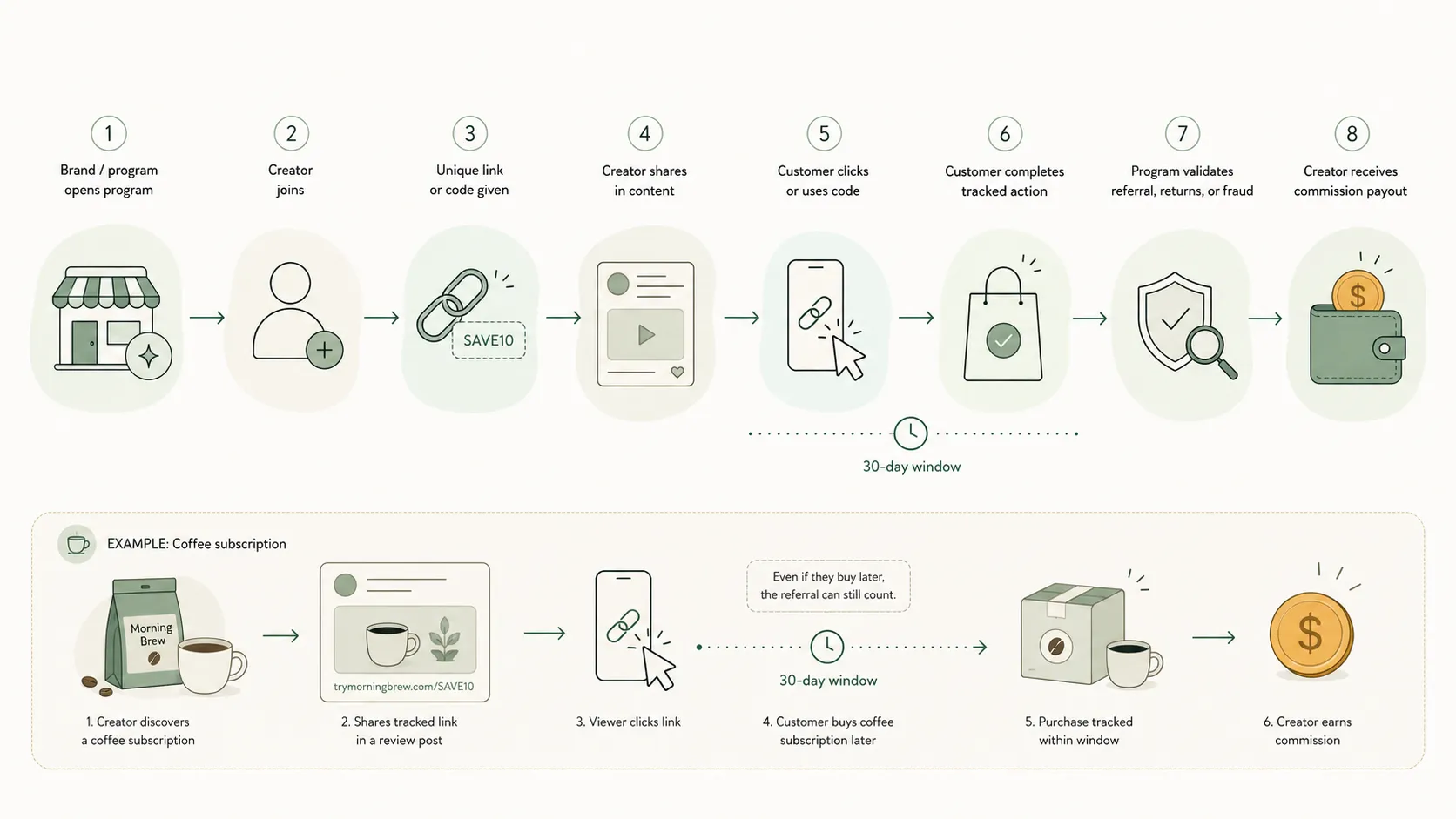
- The affiliate joins a program run by a brand, retailer, marketplace, or affiliate network.
- The program gives the affiliate a unique link, product tag, storefront URL, or discount code.
- The affiliate creates useful content around the product, such as a review, tutorial, comparison, email, video, or social post.
- A customer clicks the link or uses the code, then completes a tracked action inside the attribution window.
- The affiliate program validates the action, waits for returns or fraud checks if needed, and pays the affiliate on the program's schedule.
A practical example: a creator reviews a coffee subscription, drops their tracked link in the YouTube description, and earns a fixed fifteen dollars on every first box that ships through that link for the next thirty days. The cookie window is what makes that thirty-day delay possible. The customer can click on Tuesday, think about it, and finally check out on Thursday week, and the system still attributes the order to the original creator.
How do affiliate marketers get paid?
The commission model is the part most people get wrong when they hear the phrase for the first time. There is no single rate, trigger, or payout schedule. These five shapes cover most programs a creator will run into.
Pay per sale. The most common model on the consumer side. The brand pays a percentage of the order value, often somewhere between five and thirty percent depending on the product margin.
Pay per lead. Used heavily for SaaS, finance, insurance, and education products where the customer path is longer. The brand pays a flat fee for every qualified sign-up, demo booking, application, or quote request.
Pay per click. The affiliate earns a smaller amount for each qualified click. This is less common for creator programs because a click is easier to inflate than a sale or lead.
Pay per install or per action. Popular with apps and games. The payout fires when the customer installs, completes onboarding, starts a trial, or hits a defined in-product event.
Recurring commission. Common with subscription tools. The affiliate keeps earning a percentage every month the customer keeps paying, sometimes for the lifetime of the account, sometimes for a capped window.
Before joining a program, check the details that change the real economics: commission rate, cookie window, payout threshold, payment method, return period, whether commissions are recurring, whether coupon codes track without a click, and whether the brand allows your main traffic source. A great commission rate is less useful if the cookie window is tiny, the product does not convert, or the program bans the platform where your audience actually pays attention.
Who's involved in an affiliate program?
Affiliate marketing always involves four roles, even when one platform seems to be doing most of the work behind the scenes.
The merchant
The brand, retailer, marketplace, SaaS company, app, or business selling the product. They set the commission rate, payout terms, creative guidelines, and rules about which traffic sources are eligible.
The affiliate
The creator, publisher, blog, comparison site, coupon hub, influencer, email list owner, or media company that promotes the product. They own the audience and the recommendation.
The customer
The person who finds the product through the affiliate, decides to buy or sign up, and completes the action that triggers the commission.
The network or tracker
The system that records who sent who. This can be a dedicated network like Impact, Awin, ShareASale, PartnerStack, Commission Factory, or Rakuten Advertising, or a brand-run program built into the storefront, like Amazon Associates or TikTok Shop Affiliate.
What are the main types of affiliate marketing?
Affiliate marketing is usually grouped into three types: unattached, related, and involved. The labels sound academic, but they describe the level of trust between the affiliate, the product, and the audience.
Unattached affiliate marketing
The affiliate promotes a product without a real connection to the niche or product. This often shows up in paid ads, generic landing pages, or thin comparison sites. It can work, but the audience has little reason to trust the recommendation.
Related affiliate marketing
The product fits the affiliate's niche, even if the affiliate has not personally used it in depth. A fitness creator promoting protein powder, a cleaning channel linking to detergent, or a design newsletter mentioning a stock-photo library would all fit here.
Involved affiliate marketing
The affiliate has used, tested, reviewed, or meaningfully demonstrated the product. This is the strongest version for creators because the recommendation carries evidence: screenshots, examples, results, demos, mistakes, trade-offs, and honest context.
For creators, involved affiliate marketing is usually the better long game. It takes more work, because you have to test the product and say something specific, but it also protects the thing that matters most: the audience believing you when you say something is worth their money.

What types of affiliates are there?
Affiliates include far more than influencers pointing at discount codes. The same model powers media sites, newsletters, comparison engines, podcasts, review channels, marketplaces, and small creators with one oddly useful blog post that ranks for years.
Content creators
People publishing videos, podcasts, articles, tutorials, newsletters, or social posts that naturally mention products their audience might need.
Influencers
Creators with an audience on Instagram, TikTok, YouTube, X, LinkedIn, Pinterest, or another social platform. They often use links, product tags, storefronts, or unique discount codes.
Bloggers and publishers
Sites that publish reviews, tutorials, listicles, buying guides, and comparison posts. Their advantage is search traffic and content that keeps working after publish day.
Review and comparison sites
Sites that help buyers compare products, plans, features, pricing, and trade-offs. These can convert well because the reader is already close to a decision.
Coupon, cashback, and loyalty sites
Sites that offer promo codes, cashback, points, or deal discovery. They can drive volume, though they may catch buyers late in the purchase path rather than creating the original demand.
Email marketers
Newsletter operators and list owners who recommend products directly to subscribers, often through launches, roundups, product picks, or seasonal campaigns.
Paid traffic affiliates
Affiliates who buy ads on search, social, native ad networks, or display placements, then send that traffic to a landing page or merchant offer.
How do you start affiliate marketing as a beginner?
The beginner version is wonderfully unglamorous. Pick a specific group of people, understand what they already buy, join a few programs that match that need, make useful content, and keep improving the placements that send real clicks and sales. The magic is mostly bookkeeping and patience wearing a better coat.
- Choose a narrow niche where you can be genuinely useful, such as home coffee gear for apartment kitchens, beginner YouTube setups, or planning tools for freelance designers.
- Pick one primary channel first. A blog, YouTube channel, TikTok account, Instagram profile, Pinterest account, newsletter, or podcast can all work, but spreading yourself thin early is a very ordinary way to quit by month two.
- Make a list of products your audience already asks about, already buys, or would need to solve the problem your content is about.
- Join relevant affiliate programs or networks, then read the rules before publishing links. Some programs restrict paid search, coupon promotion, email use, or certain social platforms.
- Create content that helps someone decide: reviews, tutorials, comparisons, setup guides, mistakes lists, templates, checklists, or examples from your own workflow.
- Add affiliate links where they help the reader or viewer take the next step, then disclose the relationship clearly.
- Track clicks, conversion rate, revenue, refunds, and which content drove the action. Then make more of the useful stuff and prune the lazy stuff.
Starting with no money is possible because most affiliate programs are free to join. The real cost is time. You need enough useful content for people to find you, enough trust for them to believe you, and enough patience to keep publishing before the first commission email turns up and makes your morning feel slightly less ridiculous.
How do you choose an affiliate niche?
A good affiliate niche sits in the overlap between audience need, product demand, commission potential, and your ability to keep talking about the topic without sounding like you have been assigned homework. Profit matters, but so does stamina.
Technology and software
SaaS tools, creator tools, ecommerce apps, hosting, cybersecurity, AI tools, and productivity software often pay higher commissions because customer value is high.
Personal finance
Budgeting apps, investing platforms, credit products, insurance, tax tools, and education products can be lucrative, but the trust bar is high and claims need careful handling.
Health, fitness, and wellness
Equipment, apps, supplements, programs, wearables, and wellness products have strong demand. This niche needs extra honesty because bad advice can hurt people.
Beauty, fashion, and home
These categories work well on visual platforms and through storefronts, product roundups, tutorials, routines, and seasonal content.
Travel and experiences
Travel gear, booking platforms, insurance, tours, luggage, cameras, and eSIMs can fit well when the content is specific and practical.
Education and careers
Courses, certification programs, books, templates, coaching tools, and job-search products can convert when the audience is actively trying to improve a skill or outcome.
The simple test is this: can you name ten specific questions people in the niche ask before buying? If you can, you have content angles. Can you name five products you would mention without wincing? If you can, you have program candidates. Can you explain the trade-offs honestly? If you can, you have a chance of earning trust.
How do you get affiliate links?
You get affiliate links by joining a program, getting approved, and generating tracked URLs inside the program dashboard. Some brands run their own programs. Others use networks that group thousands of brands into one login.
- Search for the brand name plus “affiliate program” or “partner program” and look for a page on the brand's own site.
- Join networks such as Impact, Awin, ShareASale, PartnerStack, Rakuten Advertising, Commission Factory, ClickBank, or Amazon Associates, then apply to programs that fit your niche.
- Check creator-native programs such as TikTok Shop Affiliate, YouTube Shopping affiliate, Amazon Storefronts, LTK, or brand ambassador programs when they fit your platform.
- Ask brands you already use whether they have a creator, partner, or referral program, especially if you can show relevant content and a clear audience.
A few official program pages worth checking early are TikTok for Business Affiliate Program, TikTok Shop Affiliate, Amazon Associates, and the YouTube Shopping affiliate program. They are useful because they show the real mechanics: product tagging, storefronts, eligible offers, commission rates, and platform-specific rules.

Once you are approved, create a separate link for each placement where the dashboard allows it. A link for a YouTube description, another for an Instagram bio, and another for a newsletter will teach you more than one generic link copied everywhere. If the program does not make this easy, add UTM parameters before you publish.
What does affiliate marketing look like on social media?
Affiliate marketing started life on the open web, in the era of long review blogs and comparison sites. A lot of today's creator volume lives on social, because the recommendation, the trust, and the audience all sit in the same feed. The shapes you will recognise the most:

- Instagram bio links, broadcast channels, and Stories link stickers pointing at a product or a link-in-bio page with several tracked offers.
- TikTok creator codes, TikTok Shop affiliate product cards, and videos where the product is part of the demonstration rather than pasted on at the end.
- YouTube description links, pinned comments, product tags, and “gear I use” sections that keep earning from evergreen videos.
- Pinterest pins that route directly to a tracked product page, especially in the home, fashion, beauty, travel, recipe, and craft niches.
- LinkedIn newsletters, X threads, and Substack issues where a professional recommends the software they use, with a clearly marked partner link.
- Podcasts and short clips that use memorable discount codes because a listener may hear the recommendation while walking, driving, or doing three other things badly at once.
The throughline is that affiliate marketing rewards consistency. One review post might earn a few sales the week it goes live, but the same post linked from a YouTube description, a Pinterest board, a newsletter back-issue, and a pinned Instagram comment can keep paying for years. Which is also why the planning side of it matters.
How do affiliates track sales and disclose paid links?
Tracking is the part that makes affiliate marketing work as a business model. Two layers of it usually run side by side: the brand's own attribution system, which decides who gets paid, and the creator's personal analytics, which tell them which post or platform sent the traffic.
On the creator side, that almost always means tagging the link with UTM parameters before publishing. A clean utm_source, utm_medium, and utm_campaign on every link makes it possible to look at a campaign report later and see whether the Instagram Reel, the YouTube short, or the Pinterest pin actually did the heavy lifting. If the link goes out untagged, the report becomes guesswork.
On the legal side, almost every market now requires clear disclosure when a recommendation is paid. The FTC in the United States, ASA and CAP in the United Kingdom, and the AANA Code of Ethics in Australia all expect the affiliate or partnership relationship to be obvious to the audience before they click. In practice that means a visible #ad, #affiliate, “affiliate link,” “I may earn a commission,” or platform-native paid partnership label, near the recommendation rather than buried in a bio or footer.
For a deeper walkthrough of the tracking side, the UTM builder is a free way to keep campaign names consistent before the report gets noisy.
How much can you make from affiliate marketing?
The honest answer is that affiliate income ranges from nothing to a serious monthly line item, and the spread is wide because the inputs are wide. Audience trust, product price, commission rate, cookie window, content format, and buyer intent all matter more than follower count on its own.
The math is usually plain once you write it down. A ten percent commission on an eighty dollar product is eight dollars. A recurring twenty-five dollar commission on ten active software referrals is two hundred and fifty dollars a month. High-ticket affiliate marketing can pay much more per sale, but it usually needs a warmer audience, a longer explanation, and more trust than a quick product mention in a feed post.
Beginner affiliates. Often earn nothing for a while, then small commissions as a few posts start ranking, getting saved, or sending clicks. A first-year range of zero to a few hundred dollars a month is a more grounded expectation than instant passive income.
Growing creators. Can earn a few hundred to several thousand dollars a month when they have a clear niche, recurring traffic, and products that match buyer intent.
Established publishers and creators. Can make affiliate income a major revenue line, especially in software, finance, ecommerce, education, beauty, travel, and comparison-heavy niches.
Affiliate-first businesses. Large review sites, comparison publishers, and media companies can build entire businesses on affiliate revenue, but they usually have years of content, search authority, compliance systems, and dedicated analytics behind them.
For beginners, the better question is whether the content can keep finding the right person after publish day. Searchable videos, helpful comparison posts, evergreen tutorials, and saved social posts tend to do more for affiliate income than a one-off mention that disappears down the feed by dinner. For more creator income context, see our guide to how content creators make money.
What mistakes should beginners avoid with affiliate marketing?
Most affiliate mistakes come from trying to make the link do the work the content was supposed to do. A link can track a decision. It cannot create trust out of thin air.
Promoting products you would not recommend privately
If you would feel awkward recommending the product to a friend, your audience will probably sense the wobble too.
Hiding the affiliate relationship
Disclosure is a legal requirement in many markets and a trust requirement everywhere. Put it where people can see it before they click.
Publishing thin link pages
A page that is mostly buttons, coupons, and borrowed product claims gives search engines and readers very little reason to care.
Choosing programs only by commission rate
A high commission on a product nobody buys is less valuable than a modest commission on a product your audience already wants.
Ignoring cookie windows and attribution rules
Some programs credit the last click, some credit the first click, some have short cookie windows, and some exclude coupon or paid traffic. Read the boring part before building a campaign around it.
Using one program as the whole business
Programs change rates, shut categories, alter terms, or reject traffic sources. A small set of good-fit programs is sturdier than one fragile income line.
Forgetting to update old content
Prices change, products go out of stock, programs close, screenshots age, and better options appear. Old affiliate content needs a calendar reminder instead of a ceremonial burial.
Is affiliate marketing worth it for creators?
For most full-time creators the practical answer is yes, when the product fits the audience and the recommendation would still make sense without a commission attached. It is usually one income line among several: ad revenue, brand sponsorships, owned products, paid memberships, services, and affiliate commissions. Affiliate is often the line that takes the longest to warm up, because it depends on trust, but it can also be patient once it works.
It also rewards a different mindset to sponsorships. A sponsorship pays for the placement; affiliate pays for the result. That changes which products a creator is willing to recommend in the first place, because anything that does not actually work for the audience will quietly stop converting and the income line will thin out on its own.
For most creators the best version looks like a small list of genuinely useful products, mentioned naturally across a few different formats, with disclosure handled cleanly and the links tagged well enough that the monthly review tells a story rather than a shrug.
Affiliate marketing FAQ
Is affiliate marketing legit?
Yes, affiliate marketing is legit when the recommendation is real, the paid relationship is disclosed clearly, and the commission is tracked honestly. It becomes suspect when someone hides the commercial relationship, promotes products they have not evaluated, or sells the idea as guaranteed easy money.
Is affiliate marketing legal?
Yes, affiliate marketing is legal in the United States, Australia, the United Kingdom, and many other markets. The important rule is disclosure: if you can earn money from a link or code, the audience needs to know before they click or buy.
What is an affiliate link?
An affiliate link is a URL with tracking information inside it. When someone clicks that link and later buys, signs up, installs, or completes another approved action, the affiliate program can credit the right affiliate.
How do you get affiliate links?
You get affiliate links by joining a brand's affiliate program or an affiliate network, getting approved, and generating tracked links inside the affiliate dashboard. Some programs also give you unique discount codes, product tags, or storefront links.
Do you need a website to do affiliate marketing?
No. A website helps for search traffic and evergreen reviews, but creators can run affiliate marketing through YouTube descriptions, TikTok Shop, Instagram bio links, Pinterest pins, newsletters, podcasts, and other places where a tracked link or code can be shared.
How do you start affiliate marketing with no money?
Start with products you already use and can recommend honestly, join a free affiliate program in that niche, create useful content around the problem the product solves, disclose the relationship, and track every link with clean campaign names. The cost is mostly time and consistency.
How long does it take to make money from affiliate marketing?
Some creators make a commission quickly if they already have trust and traffic, but most beginners should expect a slow start. Affiliate income usually comes after enough helpful content has been published, indexed, shared, or saved for the right buyer to find it.
What is the difference between affiliate marketing and referral marketing?
Affiliate marketing usually pays creators, publishers, or partners for sending customers they may not personally know. Referral marketing usually rewards existing customers for recommending a product to friends, colleagues, or their own network.