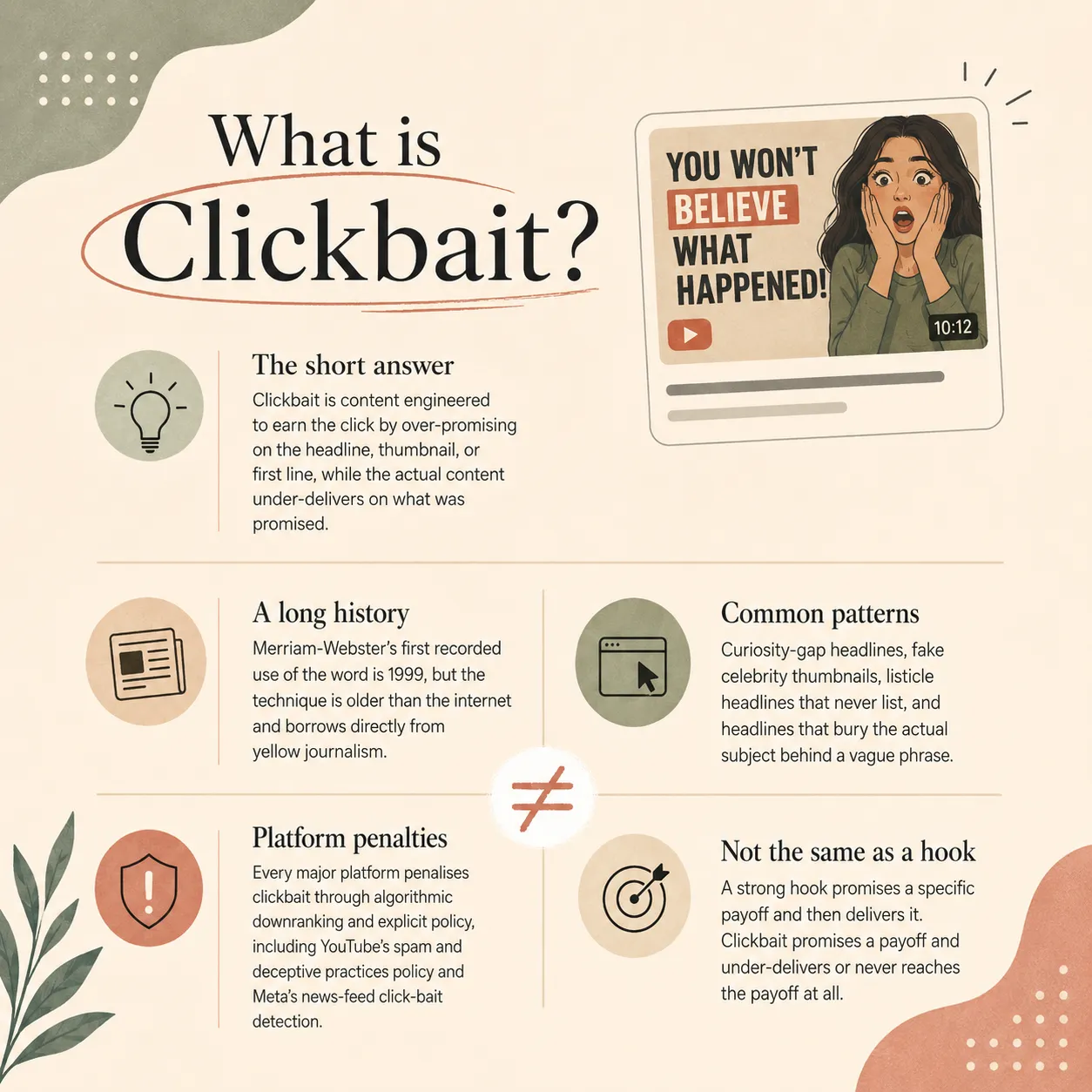
Clickbait is a headline, thumbnail, or post designed to make a user click by over-promising or withholding what the content is actually about, so the engagement signal is real but the underlying content under-delivers.
What is clickbait?
Clickbait is what you call a piece of content whose entire job is to get the click. The headline does not describe what the article is about, the thumbnail shows a face that never appears in the video, the first line of the post leans on a question the reader has to click to answer. The content behind the click is usually thin, sometimes off-topic, and almost always less interesting than the wrapper made it sound. The technique works because curiosity is hard to ignore, and the platform pays for clicks long before it measures whether the click was worth anything.
Merriam-Webster defines clickbait as "something (such as a headline) designed to make readers want to click on a hyperlink especially when the link leads to content of dubious value or interest". The dubious-value half of that line is the one that matters. A post that earns the click and then pays off is a strong hook. A post that earns the click and then under-delivers is clickbait. The difference shows up in the body, not the headline.
The reason marketers and creators care about the distinction is that platforms now measure both halves. The click-through rate lifts on a clickbait headline, watch time and time-on-page drop on a thin payoff, and the ranking system reads the gap between the two as a negative signal. A post can win the first hour of distribution on the back of the click and then lose the next week as the algorithm decides the audience did not get what they came for.
Where did the word clickbait come from?
Merriam-Webster lists the first recorded use of the word at 1999, about the same time blogs and online news outlets started competing for clicks against magazine and newspaper websites that priced ads by impression. The technique is much older than the word. Yellow journalism in the 1890s ran sensational headlines over thin stories for exactly the same reason online publishers do it now: the headline is what sells the paper, the body only has to exist.
The modern shape of clickbait took off between 2010 and 2014, when sites like Upworthy and BuzzFeed scaled the curiosity-gap headline into an editorial format. "You won't believe what happened next" and "This one weird trick" both come out of that period. Facebook's 2014 announcement on News Feed click-baiting is the moment platforms started treating clickbait as a ranking problem rather than a stylistic choice, and most of the modern-day algorithmic penalties trace back to that change.
What are common clickbait patterns?
Clickbait is not a single technique, it is a family of them. The family is small enough to recognise on sight.
Curiosity gap
The headline hints at something interesting without ever naming it. "What this teacher did to her class will leave you speechless." The reader has to click to find out what actually happened, and the body almost always pays off less than the implied promise. This is the original clickbait shape and still the most common one.
Fake thumbnail
Most common on YouTube. The thumbnail shows a celebrity, a dramatic scene, or a result that the video never delivers. A title like "I met Taylor Swift at a coffee shop" with a thumbnail of the creator next to a Taylor Swift photo is the textbook example. The video is a vlog where Swift is never mentioned. Platforms now treat misleading thumbnails the same way they treat misleading text headlines.
Listicle that never lists
A headline promises a count ("7 ways to fix your sleep") and the article delivers three watered-down points padded with stock photos. The count was the bait, the body never had seven of anything. The promise of a list is one of the more reliable engagement triggers, which is why this pattern survived even after the rest of the curiosity-gap headline lost its edge.
Bait headline, bait-and-switch body
The headline promises one topic, the body covers a different one. A blog post titled "How I quit my job and made six figures from a beach" turns out to be an affiliate page for a course. The click counts, the conversion does not, and the post burns trust on the way out.
Outrage hook
The headline is engineered to make the reader angry, scared, or both. "They are coming for your pension" or "This is why your boss hates you". Outrage performs because anger drives clicks and shares faster than calm interest, and the body almost never supports the strength of the headline.
False urgency or scarcity
"Last chance", "only 3 left", "price goes up in an hour" attached to a post that has no real deadline. The bait is the urgency, the body is the same evergreen content that was there yesterday. Platforms tend to catch this faster than other patterns because the ad systems flag false-claim wording.
Pixel of a celebrity
A thumbnail or feature image that includes a tiny inset of a famous face the post never mentions. Photo dumps of "my recent week" that happen to include a frame of Elon Musk in the corner. The face does the bait work for free, the post does not have to deliver on it.
A useful test for whether a piece of copy has crossed into one of these shapes is to ask whether you can still write the headline once you have removed the curiosity gap. If the headline survives a literal description of what the content actually does, it was a hook. If it stops working the second you describe the content honestly, it was clickbait.
How do platforms penalise clickbait?
Every major platform now has a policy line on clickbait and a ranking response to it. The two work together: the policy lets the platform remove or demonetise the worst cases, the ranking signal lets the rest of the system quietly demote everything else.
YouTube
YouTube's spam, deceptive practices, and scams policy explicitly bans "using the title, thumbnails, or description to trick users into believing the content is something it is not". The policy is enforced with video removals and channel-level monetisation actions. On top of that, YouTube's ranking system reads short watch time and high bounce rate as a downranking signal, so a clickbait thumbnail that earns the click and loses the viewer in 30 seconds usually fails on the second metric even when it does not trigger the policy line.
Meta (Facebook and Instagram)
Meta has been adjusting News Feed against clickbait since the 2014 click-baiting announcement, which introduced the time-spent-on-page and engagement-ratio signals that flag a clickbait headline even when the platform cannot read the article body. The detection has moved to a per-post classifier since then, and the same logic now applies to Instagram in- feed posts and Reels.
Google Search
Google's spam policies cover deceptive titles, doorway pages, and thin-content pages that exist primarily to capture clicks. The Helpful Content system, introduced in 2022 and rolled into core ranking in 2024, demotes whole sites that lean on clickbait headlines over real content. A clickbait headline can still rank for a day, the site behind it tends to lose ground over months.
X (formerly Twitter)
X penalises misleading content under its civic-integrity and synthetic-media rules, and the algorithm now measures dwell time on linked articles. Long-form posts that bait the click and under-deliver are downranked when a measurable share of clickers bounce within seconds. There is no specific clickbait policy line in the rules, the ranking response does most of the work.
TikTok
TikTok's community guidelines cover misleading content under integrity and authenticity, including thumbnails or AI-generated previews that misrepresent the video. The ranking system also reads completion rate and rewatch rate, which together do most of the lifting against clickbait. A clickbait hook that does not deliver a payoff in the first three seconds bleeds completion rate fast.
The pattern across all five is the same. The policy catches the worst cases, the algorithm catches the rest, and the long-term cost of clickbait is the downranking that compounds over months, not the one-off takedown.
Where is the line between a strong hook and clickbait?
A strong hook earns the click on the same promise the content delivers. Clickbait earns the click on a promise the content does not keep. The line is harder to feel from inside the work than from outside it, which is why most creators end up writing clickbait by accident at least once.
Specific over vague
"Three Instagram caption mistakes that quietly cut reach in half" describes the article. "You won't believe these caption mistakes" describes the click. The first one survives the article being honest. The second one does not.
Promise the payoff, then deliver the payoff
If the headline says the post lists seven mistakes, the post lists seven mistakes. If the thumbnail shows a finished build, the build appears in the video. The headline is a contract with the reader, and clickbait is the version of the contract that the body cannot pay out on.
Curiosity is fine, withholding is not
A hook that makes the reader curious about the answer is a hook. A hook that hides the answer behind a curiosity gap ("You'll never guess what happened") and forces the click is clickbait. Curiosity earns the click on what the post is about; withholding earns the click on what the post might be about.
Specificity in the body, not only the headline
A strong-hook headline attached to a vague body still reads as bait, because the audience felt the gap when they got there. A clickbait-shaped headline attached to a genuinely specific body sometimes survives the click, but the gap between the headline and the body is what the audience remembers.
Reasonable promises only
"How I added 100k followers in six weeks" is fine if the post explains how. "This one trick will make you go viral" is clickbait whatever the trick is, because the platform-side outcome of going viral is never something a single technique can guarantee.
The other useful frame is the brand-cost question. A clickbait post can earn one big day of attention; a brand built on clickbait headlines tends to top out at the size of the audience willing to keep clicking on bait. The work that compounds is the one that earns the click on an honest promise, which is also the work that pays back on brand awareness a year later.
How do you write headlines that earn the click honestly?
Strong headlines and captions are not the opposite of clickbait, they are the version of clickbait that delivers. The habits below tend to be what separates the two.
- Write the body before the headline. A headline drafted before the body tends to over-promise, because the writer can imagine a payoff that does not exist. A headline drafted from a finished body has to describe what is actually there.
- Use the most specific number in the post. "Three" is more honest than "a few", "30%" is more honest than "a lot", and specificity is what makes a hook feel like a promise the body can keep.
- Test the headline against the body out loud. Read the headline, then read the first paragraph of the body. If the body has to apologise for the headline, the headline is clickbait. If the body keeps the promise without re-explaining it, the headline is fine.
- Cut the throat-clearing words."You won't believe", "this will shock you", "the truth about". All of them shift the value from the topic to the curiosity gap. Take them out and the headline has to stand on the topic instead.
- Match the visual to the body. A thumbnail or feature image showing something the post does not contain is clickbait even when the headline is honest, because the visual is doing the bait work on its own. Pick a frame that the post actually delivers.
- Watch the dwell-time and watch-time data. If the click-through rate is high and the dwell time is low, the headline is over-promising. The numbers will say clickbait long before the audience does.
- Edit the caption as carefully as the headline. A clickbait headline attached to a thoughtful caption is still clickbait, because the click happens before the caption gets read. The caption and the headline have to make the same promise.
Clickbait FAQ
What is an example of clickbait?
A headline like "You won't BELIEVE what this 5-year-old did next" or a YouTube thumbnail of a celebrity who never appears in the video. Both are designed to force the click by withholding the answer and over-promising on the payoff. The tell is that you cannot work out what the post is actually about until after you have clicked, and the content then under-delivers on whatever the headline implied.
Is clickbait illegal?
No, clickbait is not illegal in most countries. It is against the spam and deceptive-practices policies of every major platform, including YouTube, Meta, and Google Search, and it can get a creator demonetised, downranked, or removed from monetisation programmes. Some specific clickbait patterns (fake celebrity endorsements, misleading product claims) can also cross into consumer-protection or advertising-standards territory, which is regulated separately.
What is the difference between clickbait and a good headline?
A good headline promises a specific payoff and then delivers it. A clickbait headline promises a payoff and either under-delivers or never gets to the payoff at all. The headline "Three mistakes that quietly kill engagement on Instagram" is a strong hook if the post lists three specific mistakes. The same headline is clickbait if the post lists one mistake, none of them, or a thin rewrite of advice everyone already knows. Specificity in the body is what separates the two.
Does YouTube penalise clickbait?
Yes. YouTube's spam, deceptive practices, and scams policy explicitly bans misleading titles, thumbnails, and descriptions, and the ranking system also measures watch time and session quality as part of distribution. A clickbait thumbnail that earns the click and then loses the viewer in the first 30 seconds tends to under-perform over the long run, because YouTube reads short watch time as a negative signal. Repeated violations can lead to monetisation removal or video takedowns.
Why do people still use clickbait if it gets penalised?
Because the first 24 hours of clicks are a stronger signal than the long-tail penalty, especially for accounts that monetise on impression-based ad revenue or affiliate links. A clickbait headline lifts the click-through rate, and the creator collects the impressions before the platform downranks the post. The pattern works once or twice, the audience eventually learns to distrust the account, and the channel ends up smaller than it would have been with honest headlines.