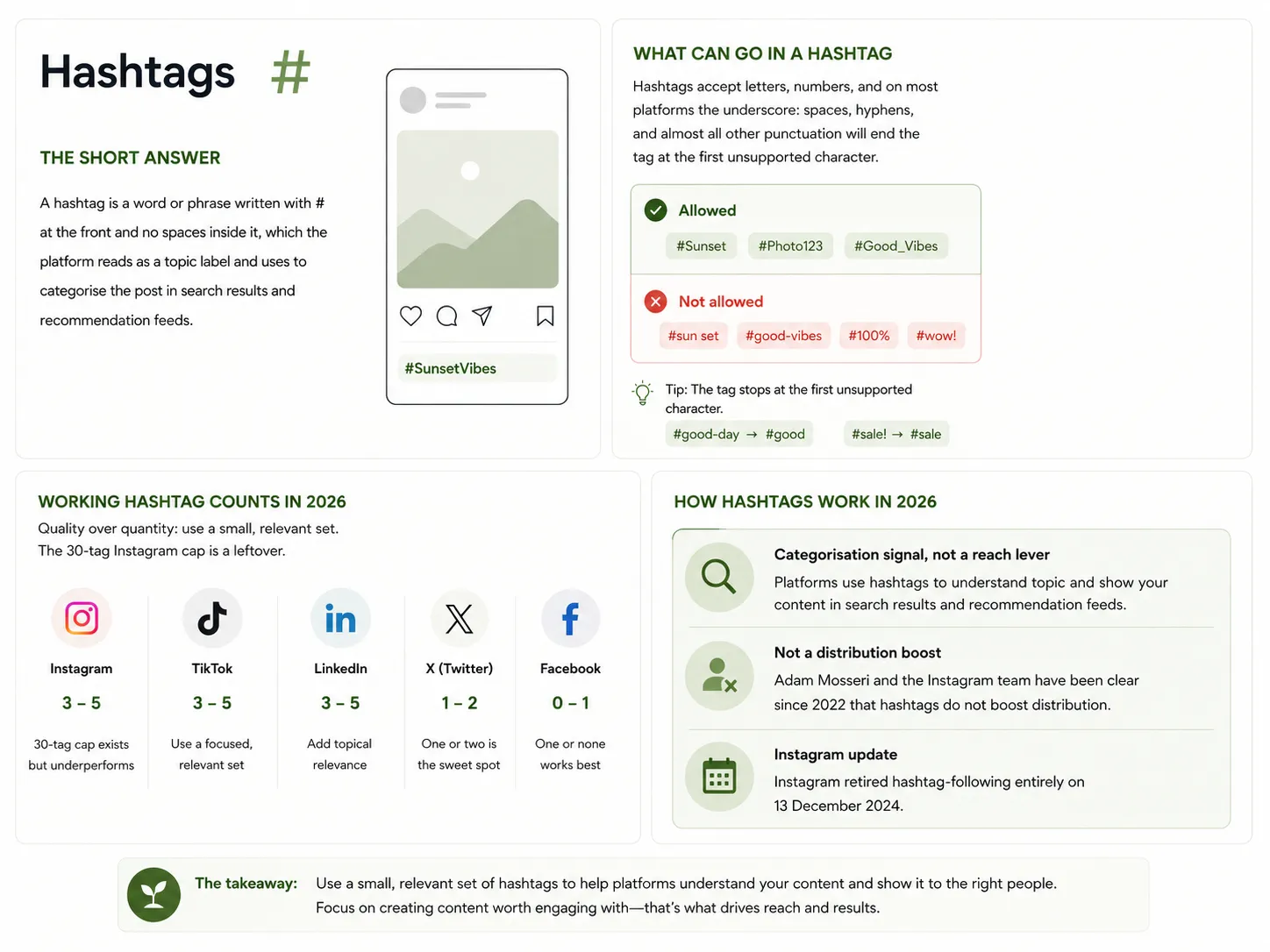
A hashtag is a word or phrase preceded by the # symbol, written with no spaces inside it, that labels a social media post by topic so the platform can group it with other posts using the same tag and surface it through search and recommendation feeds.
What is a hashtag?
A hashtag is the # symbol followed by a string of letters or numbers, written without any spaces, used inside a social media post to mark what the post is about. The Wikipedia entry on the hashtag defines it more formally as a metadata tag prefaced by the hash symbol that enables user-generated tagging for cross-referencing content by topic. In practice that definition collapses to one job: the hashtag tells the platform, and anyone reading the post, what topic the post belongs to so it can be grouped with the rest of the posts on that topic.
The # symbol on its own has been around for a long time (typesetters called it the octothorpe, telephone keypads label it the pound key in the United States and the hash key almost everywhere else, and IRC channels used # in front of channel names from the late 1980s onwards). The convention of putting # in front of a topic word and treating the result as a clickable, searchable label is the social media usage that the word hashtag now refers to.
On every major platform a hashtag is clickable. Tapping it takes the reader to a feed (or a search result) of other posts using the same tag. That feed is the part that gives hashtags their original power: it turned a private piece of metadata into a shared, browsable cross-platform index. The shape of what that index actually delivers in 2026 has changed a lot, which is most of what the rest of this page is about.
The rules for what counts as a hashtag
The basic syntax is the same on Instagram, TikTok, X, LinkedIn, Threads, Facebook, YouTube, and Pinterest. A hashtag starts with the # character, then runs through letters and numbers (and on most platforms the underscore) until it hits a character the platform does not accept, at which point the tag ends. So #blackfriday2026 is one tag, while #black-friday-2026 ends at the first dash and only #black gets tagged.
What works
Letters in any case (the platform treats #FYP and #fyp as the same tag), numbers in any position (#bestof2025 is fine), and underscores on Instagram, X, TikTok, and LinkedIn (#small_business is one tag). Some scripts beyond Latin work as expected (Cyrillic, Arabic, Japanese, Korean), and emoji can be used inside a hashtag on Instagram and TikTok though support is uneven.
What breaks the tag
Spaces end the tag at the first space (#small business is just #small with the word business untagged after it). Hyphens, dots, slashes, ampersands, dollar signs, percent signs, and most other punctuation also end the tag. The fix is to write multiple words as one continuous string (#smallbusiness) or to capitalise each word for legibility (#SmallBusiness, sometimes called CamelCase).
Practical hashtag length
There is no hard character limit on the tag itself on most platforms (the limit is the caption character limit), but readability collapses past about 25 characters and the tag stops being useful. The middle ground that actually gets typed into search bars is between 4 and 20 characters.
Capitalisation and accessibility
Capitalising each word (#GetReadyWithMe rather than #getreadywithme) does not change which posts the tag matches but makes it possible to read at a glance and lets screen readers parse the words separately. The accessibility version is the one most platforms now show as the recommended style.
Two platform-specific edges are worth knowing about. Instagram caps the number of hashtags in a single post at 30 across the caption and the comments combined, as their help-centre page on using hashtags states. TikTok caps the visible hashtags in the caption at five in most regions, with the caption character limit absorbing whatever is left. Both numbers are technical maxima, not recommendations.
A short history of the hashtag
The social media hashtag started life as a Twitter feature request that Twitter ignored. On 23 August 2007 the product designer Chris Messina posted the now-famous tweet proposing “how do you feel about using # (pound) for groups. As in #barcamp [msg]?”. He had borrowed the idea from the way IRC channels prefixed channel names with # since the late 1980s. Buffer's history piece on the origin of Twitter hashtags records the awkward middle: Twitter co-founder Evan Williams told Messina the idea was too nerdy to take off, and the company declined to build any official support for it.
That changed in October 2007, when the San Diego wildfires hit and Messina pushed the use of #sandiegofire as a way for Twitter users to coordinate real-time information about the fires. The tag worked, the convention caught on through pure user behaviour, and Twitter eventually capitulated. From 2 July 2009 the platform started turning every hashtag in every tweet into a clickable link to the search result for that tag, which is the moment the hashtag stopped being a community convention and became a built-in feature.
From there the convention spread fast. Instagram added hashtag support in early 2011, Facebook (after holding out for years) in 2013, LinkedIn in 2018 after a few earlier failed attempts, TikTok inheriting the convention from its predecessor Musical.ly the same year, and YouTube formally introducing clickable hashtags above and inside video descriptions in 2018. By the mid-2010s the hashtag was the cross-platform default for marking what a post was about.
The hashtag also became a vehicle for collective action. Movement hashtags such as #BlackLivesMatter (2013), #MeToo (2017), and #JeSuisCharlie (2015) showed that the convention could organise enormous coordinated conversations across platforms and time zones. The Oxford English Dictionary added hashtag as an entry in June 2014, with the definition narrowed to the social media usage rather than the symbol itself.
What hashtags actually do on each platform in 2026
The job a hashtag does has narrowed since the era when adding twenty of them on Instagram visibly lifted reach. The platforms that grew up around recommendation feeds (TikTok first, then Reels, Shorts, and X For You) now decide distribution from a wider mix of signals, with hashtags sitting alongside captions, on-screen text, audio, watch-time, sends, and saves. The shape of that role is different on each surface.
Hashtags are a categorisation signal that helps Instagram decide what topic a post belongs to and which Explore and Reels audiences to test it against. They are no longer a way to build a follow-through audience: Instagram retired the ability to follow a hashtag on 13 December 2024, as Social Media Today reported, so a tagged post no longer lands in anyone's home feed by virtue of the tag itself. Search still works, the categorisation effect still applies, and a small set of relevant tags still helps a post get tested against the right unconnected reach.
TikTok
The For You feed is driven mostly by watch-time, completion rate, sends, and topical interest signals. Hashtags help the algorithm understand what topic the video belongs to and surface it on the relevant interest cluster. Three to five tags is the standard recommendation across TikTok-focused guides; more than five clutters the caption and gives the system mixed signals about what the video is.
Hashtags work as topical metadata for the algorithm and as ranking input for LinkedIn's internal search. They are no longer a discovery surface in the way they were in 2019 (LinkedIn's hashtag-feed pages have been quietly de-emphasised), but they still help a post get categorised against the right topical audience. Two to three is the LinkedIn-native recommendation that most active LinkedIn voices have settled on.
X (formerly Twitter)
X has the longest hashtag history of any platform and is the one place trending hashtag pages still drive a meaningful share of attention, especially around live events, sports, and breaking news. One or two hashtags per post is the working rule; the For You algorithm in 2026 down-weights posts with more than two hashtags as a spam signal.
YouTube
Hashtags appear in two places on YouTube: in the video description (the first three are pulled up above the title and become clickable category links) and in the title itself (clickable but visually noisy). They categorise videos for search and the Shorts feed, and they help the recommendations engine understand what the video is about. Three to five in the description is the most common YouTuber-side practice.
Hashtags work technically (they are clickable and they show up in search) but contribute almost nothing to organic distribution on Facebook in 2026. Most brands now leave them off Facebook posts entirely, or include one branded campaign tag if a campaign is running across platforms.
Threads and Bluesky
Threads launched without hashtag support and added a one-hashtag-per-post limit in 2024, with the tag styled as a small chip rather than inline blue text. Bluesky supports hashtags in the standard syntax. Both platforms treat tags as topical metadata for search rather than a discovery feed in their own right.
Pinterest deprecated the use of hashtags in pin descriptions in 2020 and now treats them as ordinary text rather than a topical signal. The categorisation work on Pinterest is done by board names, pin titles, and the description text itself.
The shared pattern across the eight is that hashtags help the platform understand the topic of the post but no longer act as the lever that grows distribution. Adam Mosseri's public explainer on Instagram ranking makes the same point from inside the company: ranking is built from a mix of signals about the post and the viewer, and hashtags are one input among many rather than a multiplier on their own.
How many hashtags to use by platform
The numbers below are the working consensus from the platform-native and the major social-tool guides, including Sprout Social's reference piece on what hashtagging is and Later's 2026 guide to Instagram hashtags. They reflect what is actually performing rather than what the technical maximum allows.
Instagram: 3 to 5
Down from the 11 to 30 that worked in the late 2010s. Use a small relevant set, place them in the caption (or in the first comment if you want a cleaner caption), and avoid the giant tag-stack that used to be standard. The technical maximum is 30 in the caption and comments combined, but the algorithmic and reader cost of using all 30 is now larger than any benefit it produces.
TikTok: 3 to 5
One broad tag the audience already searches for, two or three niche tags that match the actual subject of the video, and (optionally) one branded tag for the account or campaign. The visible cap on TikTok captions is five hashtags in most regions.
LinkedIn: 2 to 3
Picked from the topic vocabulary the audience uses on LinkedIn (so #b2bmarketing rather than #b2b for a B2B marketing post), placed at the end of the post body. More than five reads as spammy and the engagement rate drops with each additional tag past about three.
X: 1 to 2
X is the platform where the trending hashtag still drives real attention, especially around live events. One topical tag per post is the working rule; two if one of them is a branded or event tag and the other is the broader topic.
YouTube: 3 to 5 in the description, 0 in the title
Hashtags in the description work as topical metadata and the first three appear as clickable links above the title. Hashtags in the title itself are visible but tend to make the title harder to read and click; most YouTube growth advice in 2026 is to keep the title clean and put the tags in the description.
Facebook: 0 to 1
Most posts get nothing from hashtags on Facebook in 2026. The exception is a single branded campaign tag carried across platforms, where the value is consistency rather than reach.
Threads: 1
One per post is the cap. The tag is rendered as a small chip rather than inline text, so a single relevant tag is the only call to make.
Pinterest: 0
Hashtags in pin descriptions stopped doing topical work in 2020 and the recommendation has been to leave them out since.
The number that gets the most traffic from teams switching from the 30-tag era is the Instagram one. The honest answer is that the change happened around 2022, was reinforced when Instagram retired hashtag-following at the end of 2024, and the working benchmark across Sprout, Later, Hootsuite, and Buffer has settled on three to five since.
Types of hashtag
Hashtags get sorted into a few standard categories that decide what work each one is doing in the post. The split below is the version most social teams now use when planning a content calendar.
Topical hashtags
Tags that name the subject of the post (#smallbusiness, #recipes, #marketingstrategy, #midcenturymodern). These do the categorisation work the algorithms care about and are the part of the tag mix that should be relevant rather than broad.
Branded hashtags
Tags unique to the brand or to a specific campaign (#ShareACoke, #JustDoIt, #IkeaAtMine). These exist to gather user-generated content, anchor a campaign, and create a searchable archive of mentions. Coca-Cola's #ShareACoke is the canonical example: a single brand tag that crossed national markets and held together a multi-year campaign.
Community hashtags
Tags that mark a community or recurring activity (#bookstagram, #plantsofinstagram, #devcommunity, #runnersofinstagram). These work like neighbourhood signs: posting under one signals to the people in that community that you are talking to them, and the engagement tends to come from inside the community more than from the broader algorithm.
Trending hashtags
Tags that have spiked in use over the last hours or days (#oscars, #superbowl, #blackfriday). These can lift a single post into a much larger conversation if the post has a real angle on the trend; using them with no real connection to the topic reads as opportunistic and tends to get throttled.
Event hashtags
Tags built for a specific event so attendees and people watching remotely can find each other (#cannes2026, #SXSW, #ces). Most major events publish the official tag in their conference materials.
Location hashtags
Tags built around a place (#sydneyfood, #brooklynbrunch, #devonproperty). These are the most reliably useful tag type for local businesses, where a tag of the suburb or city plus the category does most of the discovery work that location does on platforms like Google.
Holiday and observance hashtags
Tags built around days of note (#worldoceansday, #internationalwomensday, #smallbusinesssaturday). These cluster a year's worth of posting from many accounts under one tag and can lift a relevant post into the wider conversation on the day.
A workable mix on Instagram or TikTok is one broader topical tag, two niche topical tags, and (optionally) one branded tag. The same template scales down to one or two on LinkedIn and X.
How to pick the right hashtags
- Start from what is actually in the post. The first three or four tags should describe what the post is about, plainly. A post about brewing pour-over coffee at home gets #pourover, #coffeeathome, and maybe #specialtycoffee before any broader tag is considered.
- Search the tag before using it.Tap the tag in the platform's search bar and look at the top posts. If the top results are off-topic, the tag has been captured by something else and using it will categorise the post incorrectly. If the top results are spam, the tag is poisoned and worth skipping.
- Mix one broad with several specific. A tag at 5 million posts and a tag at 5,000 posts do different work; the broad one teaches the algorithm what general topic the post belongs to, and the specific one gets the post into the small enough audience where it can actually rank near the top of the tag feed for a few hours.
- Build a small bank of relevant tags per content pillar. Pre-decide eight to twelve tags for each recurring topic the account posts about, so the per-post decision is to pick three to five from a known list rather than to brainstorm on the spot. The bank gets refined every quarter as some tags fade and others rise.
- Use the platform's own search suggestions. Typing a partial tag into Instagram, TikTok, or LinkedIn search now surfaces a sorted list of related tags with post counts. That live data is more useful than any static list published in a blog post.
- Check the branded tag is not already in use. Before launching a campaign hashtag, search the exact tag on every platform the campaign is going to run on. A clash (the tag is already used by an unrelated community, or the tag is a recognised slur in another language) is the kind of avoidable mistake that turns into a press story.
- Mind capitalisation for accessibility. A long tag in CamelCase (#GetReadyWithMe rather than #getreadywithme) is parsed correctly by screen readers and easier for sighted readers to take in. The match behaviour is identical, so the choice is essentially free.
Common hashtag mistakes
- Maxing out the Instagram cap. Thirty tags on a Reel was the standard advice in 2018. In 2026 the algorithm reads a tag-stack of that size as low-intent or spam and the post tends to underperform a version of the same post with three or four well-chosen tags.
- Using #love, #instagood, and the all-time top tags. The tags with hundreds of millions of posts are so broad that the post falls out of the top results within seconds and the categorisation signal is too weak to mean anything. They are essentially noise.
- Hashtag-jacking unrelated trends. Adding #superbowl to a post that has nothing to do with the Super Bowl in the hope of stealing some of the traffic earns almost no real reach (the algorithm spots the topical mismatch) and reads to humans as exactly the cynical marketing it is.
- Putting the hashtag inside the sentence. Writing “our new #espresso machine is the #bestvalue this season” breaks reading flow, looks dated, and is the single clearest tell of a post written for the algorithm rather than a person. The convention is to put hashtags at the end of the caption (or in the first comment on Instagram).
- Forgetting the underscore-and-hyphen rule. A tag with a hyphen in it (#small-business) ends at the dash and only #small actually gets tagged. Underscores (#small_business) work; CamelCase (#SmallBusiness) is the most readable.
- Treating the same tag list as universal. A tag that performs on Instagram is rarely the right tag on LinkedIn, and the tag that works on TikTok is almost never the right tag on X. Per-platform tag selection is part of the same per-platform thinking that drives caption length, aspect ratio, and posting time decisions.
- Using a branded tag before checking it elsewhere. The branded tag clash is one of the most expensive mistakes on this list, because the cost is reputational rather than algorithmic. Search the exact tag on every platform the campaign will run on before printing it on anything.
- Following the old reach-multiplier mental model. Hashtags are no longer the lever that grows an account. The lever is the content (especially watch time and saves on video, dwell time and replies on text). Hashtags help the post get categorised so the right audience sees it; they do not, on their own, grow the audience.
For the wider context the hashtag sits inside, the caption entry covers the larger writing the hashtags hang off, the algorithm entry covers the ranking systems that decide what a tagged post actually reaches, the engagement rate entry covers the single metric most useful for telling whether a hashtag set is doing real work, and the feed entry covers the For You and recommendation surfaces that broke the old hashtag-equals-reach assumption.
The matching tools on this site cover the per-platform side of the same job: the Instagram hashtag generator and the TikTok hashtag generator produce a small relevant tag set for a given topic, the character counter helps the caption-plus-tags fit inside each platform's character limit, and the YouTube tag generator covers the description-side tags that drive YouTube's topical categorisation.
Hashtag FAQ
What is a hashtag in simple terms?
A hashtag is a word or phrase written with the # symbol in front of it and no spaces inside it (#smallbusiness, #fyp, #ShareACoke), used on social media to label what a post is about so the platform can group it with other posts on the same topic and make it findable through search and the recommendation feeds. The hashtag itself is just metadata; the work it does for an account is to tell the algorithm and any human searcher what the post belongs to.
What is a hashtag used for?
Three things, in roughly this order of importance in 2026: telling the platform what the post is about so it gets categorised and shown to the right recommendation audience; making the post findable in the search results when someone types the same word into the search bar; and gathering posts from many accounts under one campaign or community label (a branded hashtag like #ShareACoke or a movement hashtag like #MeToo). The old fourth use, building a follow-through audience by getting people to follow the hashtag itself, is mostly gone since Instagram retired hashtag-following in December 2024.
How many hashtags should I use?
Three to five is the working answer on Instagram, TikTok, and LinkedIn in 2026, with one to two on X and one or none on Facebook. The 30-tag limit Instagram still allows in the caption is a leftover from a different era; Adam Mosseri and the Instagram team have been on the record since 2022 that hashtags categorise content rather than boost reach, and posts using a small set of relevant tags now outperform posts stuffed with thirty. Pick tags that match what is actually in the post, place them at the end of the caption (or in the first comment on Instagram if you want a cleaner caption), and stop.
Do hashtags still work in 2026?
Yes, in a smaller and more specific way than they did in 2018. They no longer act as a discovery shortcut on Instagram (the For You and Reels surfaces are driven by watch time, sends, saves, and topical relevance more than by the tags on the post), and Instagram has stripped out hashtag-following entirely. They still help the algorithm categorise content, they still show up in search results when someone types the term, and they still anchor branded campaigns and community conversations on every major platform. The mistake is treating them as the lever that grows an account; they are a label that helps the post get categorised correctly.
What characters can a hashtag contain?
A hashtag starts with # and can contain letters and numbers, with most platforms also accepting the underscore. Spaces, hyphens, dots, slashes, ampersands, dollar signs, and most other punctuation will end the hashtag at the first non-supported character, which is why a tag like #small-business breaks at the dash and only #small ends up tagged. Capitalisation does not change which posts a hashtag matches (#fyp and #FYP land in the same place), but mixing case in long tags (#GetReadyWithMe rather than #getreadywithme) makes them readable and is friendlier to screen readers.
Who invented the hashtag?
Chris Messina, an American product designer, suggested using the # symbol to group Twitter posts in a tweet on 23 August 2007 ("how do you feel about using # (pound) for groups. As in #barcamp [msg]?"). Twitter initially passed on the idea as too nerdy. The convention took hold during the October 2007 San Diego forest fires, where #sandiegofire became a useful real-time channel, and Twitter started turning hashtags into clickable search links in mid-2009. Messina deliberately did not patent the idea, on the grounds that it was born of the internet and owned by no one.